


Quoting Crazy Paving: Real Waste Allowances and Labor Rates for Hardscape Contractors
Short answer: quote irregular stone as a hand-fitting job, not as a bigger paver job. Material overage for genuine crazy paving runs well above the flat-field number because the waste is driven by shape, joint width, perimeter tightness and stone brittleness, not by area alone, and the industry’s own calculators cannot see those variables. Labor is the real margin risk: irregular stone is installed by pieces and cuts, so a crew that lays one rate of machine-cut pavers lays a fraction of that area in random flagstone. The safe bid prices the two separately, sets an overage you can defend on the drawings, and builds the labor line from crew-hours measured on your own jobs rather than a copied paver productivity figure. The contractors who lose money on crazy paving almost always lose it on the labor line, not the stone.
Most hardscape bids on irregular stone start from a good instinct and a bad number. The instinct is right: crazy paving deserves a higher allowance than a modular paver run. The number is wrong when it is a single percentage typed into a spreadsheet with no idea what it is covering. This article is the contractor-side method for estimating material and labor on a flagstone or crazy-paving job so the quote wins without a hidden loss, and for explaining the price to a homeowner who thinks irregular stone should be cheap because it “looks simple.”
Separate Material Overage from Cutting Labor
The first mistake is treating overage and labor as one “waste” figure. They are different costs with different drivers, and they should be quoted on different lines. Overage is the extra square feet of stone you buy so the layout has enough pieces to fit and to keep a few spares for future repair. Cutting labor is the crew time spent breaking, trimming and dry-fitting those pieces to a boundary. A genuinely random layout with generous joints can use more stone area but need fewer saw cuts, because the joints absorb the fit. A tight, gauged layout with narrow joints needs more cutting and less leftover. Two jobs with the same square footage can therefore have very different material and labor splits, and a single blended allowance hides that from your estimate.
That distinction matters because the two numbers fail in opposite directions. Under-estimating overage costs you a mid-job re-order, a second freight movement, and a visible color break between batches. Under-estimating cutting labor costs you a crew sitting on site two days longer than the bid, which is the bigger loss and the one homeowners never see. When the job runs long you eat it; when the stone runs short the customer sees a delay. Price the cutting labor first and the overage second.
What Actually Drives Crazy Paving Waste
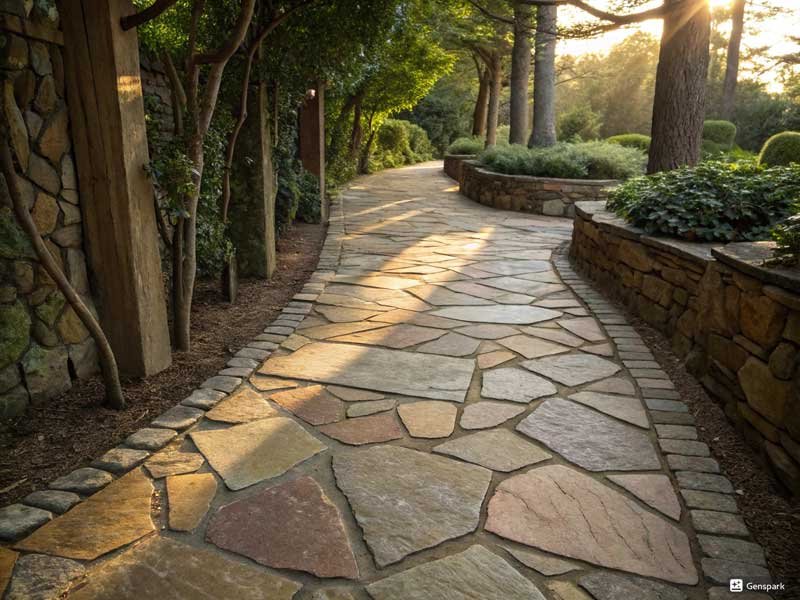
Four variables move the overage number, and the calculators that contractors reach for do not model any of them. First, perimeter geometry. A rectangular patio with square corners wastes less than a curved border, because every curve forces cuts off large pieces and leaves offcuts that will not fit the field. The tighter the radius and the more obstacles, the higher the allowance, and the trade bodies and manufacturer guides that publish generic overage percentages quietly assume a simple shape. Second, joint strategy. Dry-stacked, tight joints demand more cutting and produce more unusable offcuts than a random layout where wide, irregular joints do the fitting. Third, stone brittleness and thickness variation. A fragile sandstone with wide thickness spread breaks more during handling and cutting than a dense, gauged quartzite, so the effective waste rises with the material you actually ordered, not the material the sample showed. Fourth, the customer’s pattern intent. A client who wants a specific “no two pieces alike” look will reject repeatable modular packs, pushing the job back toward fully random fitting and higher waste.
This is why the waste-factor thinking that works on ledgestone veneer walls does not transfer cleanly to ground paving. The vertical-ledger method is written up in our guide to calculating ledgestone veneer waste factors, and its rules of thumb apply to cutting a wall to a line, not fitting a field of floor pieces to a curve. The same logic that raises a paving allowance, however, is the joint-width and perimeter logic any installer recognizes from the job.
Set the Overage From the Drawings, Not the Sample
Fix your overage against the plan before the stone ships, not against a mental average. Walk the perimeter on the drawing and count the curves, corners and cut-outs; a job with two tight radii and a round fire-pit ring is not the same as a four-square patio even at identical area. Decide the joint strategy with the client and put it in the spec, because “wide random joints” and “gauged tight joints” are two different waste numbers wearing the same name. Then add a spares allowance as a separate, deliberate line: a few square feet of the same batch, kept on site, so a future cracked piece is replaced from matching stone rather than a new color-matched order. That spares line is cheap insurance and it is the one item contractors most often skip and later regret.
Order by area, verify by piece. Because irregular packs are sold by square metre but consumed by fitting, the only real check that a container has enough coverage is a dry layout of the tightest section before you commit. The base and setting detail for the job is covered in our flagstone patio build guide, but the estimating discipline that protects the margin is the dry-fitting of a sample bay, which tells you more about true coverage than any quoted percentage.
Build the Labor Line From Crew-Hours, Not a Copied Paver Rate
This is where the money is. The productive mistake is taking your machine-paver crew rate and adding a percentage. Irregular stone is a hand-fitting and quality-control operation; the crew spends time deciding which piece goes where, breaking edges to fit, and re-setting for color balance, none of which happens in a modular run. The honest method is to measure your own crews on past crazy-paving jobs in crew-hours per installed square foot, and price from that. If you have no history, ask the trade for a planning benchmark rather than inventing a number: the Concrete Masonry and Hardscapes Association publishes installation guidance and best-practice resources that crews and estimators use as a reference for paving methods, available at icpi.org. Build your rate up from your measured hours plus a burdened crew cost, not down from a competitor’s price.
Price cutting and edge work as its own task. A curved border can add more hours than the entire field lay, and it is invisible in a per-square-foot rate until the job is over. Break the bid into field fitting, perimeter and cuts, base and setting beds, and jointing, so a slow section shows up in your next estimate instead of just erasing the margin on this one. The driveway variation, where thickness and compaction drive both material and time, is detailed in our crazy paving driveway guide, and the same itemized-estimate discipline applies there with an even heavier labor weighting.
Explain the Price to the Homeowner Without Defending It
The homeowner sees random stone and reads “imperfect, therefore cheap.” Your job is to reframe the conversation from appearance to method without sounding defensive. Say plainly that a machine-cut paver is fast because the machine did the fitting; a crazy-paving patio is slow because a crew is doing by hand the same fitting a saw did for you, and that fitting is the cost. Walk them through the four waste drivers above so they see that their own choices, curve, joint width, and pattern strictness, set the price. Offer the levers: a modular or gauged pack lowers cutting labor but trades away the fully random look; wider joints lower cuts and cost; a straight perimeter lowers the border time. Giving them the controls converts a price argument into a design decision, and it wins the bid as honestly as discounting would not.
Put the assumptions in writing. State the overage percentage you used, the joint strategy, the perimeter complexity and the crew-hour basis for the labor in the estimate itself. When the job goes smoothly, the assumptions are the proof you were accurate; when scope changes, the assumptions are where the conversation starts instead of where it ends. Homeowners do not object to fair labor once they can see what it pays for, and an itemized, assumption-clear quote is the difference between a premium bid that holds and a low bid that bleeds.
Conclusion: Estimate the Fitting, Not the Square Footage
Crazy paving margins are lost in the gap between how stone is sold and how it is laid. It is sold by area and quoted by area, but it is installed by pieces, joints and cuts, and neither your paver productivity rate nor an online calculator captures that. Price overage from the drawings and the stone’s brittleness, price labor from measured crew-hours with the perimeter broken out, and hand the homeowner the four waste levers so the price becomes a shared decision. Do that and you stop losing on the jobs where the stone looks cheapest, which are the jobs that were quietly the most expensive all along.
Frequently Asked Questions
Is crazy paving always more expensive than pavers per square foot?
Not in material, often in labor. The stone itself can cost less per square foot than premium modular pavers, but the hand-fitting and cutting push installed cost up. The gap widens with curved perimeters, tight joints and brittle stone.
Should I add overage for cutting and for spares together?
Keep them separate. Cutting waste depends on layout and should be estimated from the drawings; spares are a small deliberate allowance for future replacement, and bundling them hides both and usually leads to under-ordering spares.
How do I know my crew-hour rate is right?
Measure it on your own past jobs in hours per installed square foot, split field and border. Benchmarks from industry bodies like ICPI help you sanity-check method, but your margin comes from your crew’s actual fitted-hours, not an average.
