
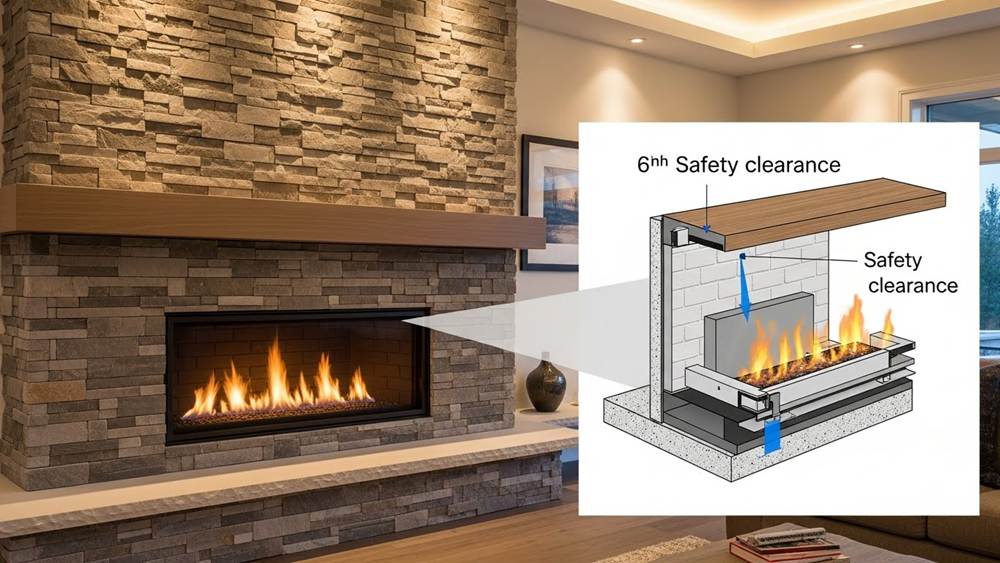
A fireplace stone veneer installation that fails inspection isn’t just a scheduling headache — it’s a liability that traces back to the spec sheet. For a veteran architect or interior designer, the margin for error on clearance, backer board, and mortar is essentially zero. The code requirements are precise, and the materials you specify have to match them exactly. Get the substrate wrong, and the entire wall assembly becomes a fire risk. Get the mortar wrong, and the stone delaminates within a season.
Most guides skip the engineering details that actually matter on a commercial job site. They recommend a scratch coat on cement board — a step that ASTM C1780 explicitly says is unnecessary when you use the right modified mortar. They suggest Type S mortar for convenience, ignoring that its polymer content is too low to grip the smooth back of a natural stone veneer on a vertical surface. That gap between common advice and code-compliant practice is where projects go sideways. This guide closes that gap with the specific specs you need to write into your next submittal.
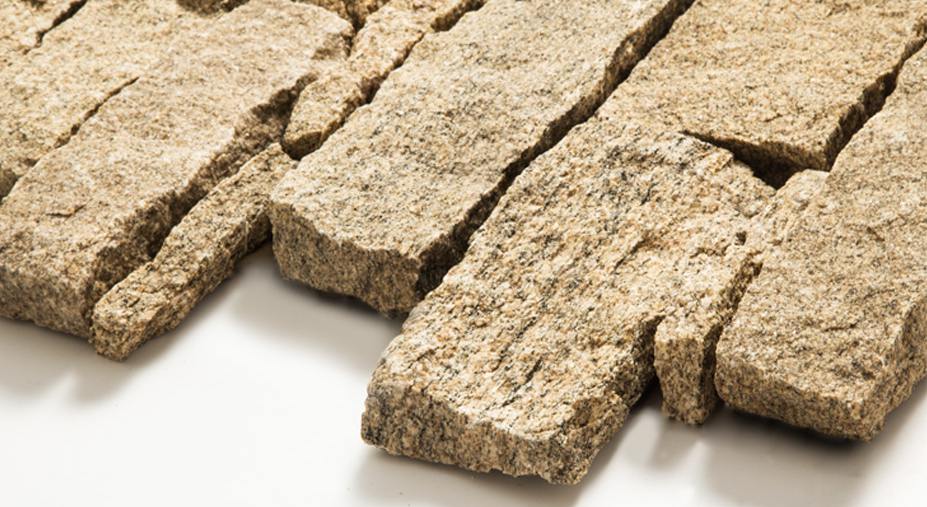
Why Most Fireplace Stone Veneer Installations Fail: The Hidden Risks
Most failures trace to one root: ignoring ASTM E136 for backer boards.
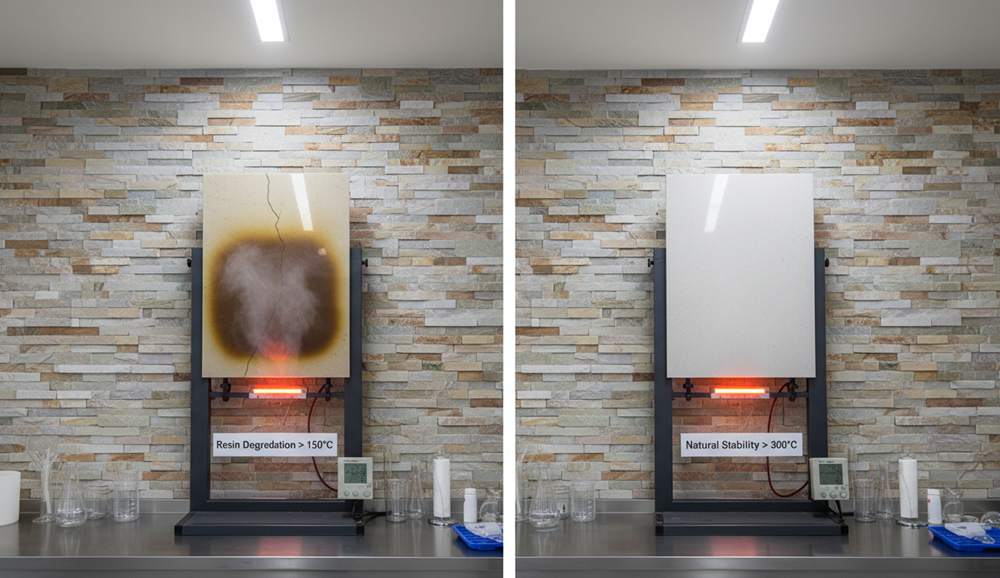
The gap between DIY tutorials and commercial building codes is not a nuance — it is a liability. A typical YouTube guide shows stone veneer applied directly over drywall with construction adhesive. That method violates IRC Section R702.3.4, which requires a non-combustible substrate meeting ASTM E136 for any fireplace surround. Drywall is not non-combustible; it chars and loses structural integrity at temperatures above 400°F. The result is a wall that can sag, crack, or collapse during a fire.
Thermal expansion compounds the problem. Natural stone and cement board both expand under heat, but at different rates. If the backer board is drywall or plywood, the differential movement creates shear stress at the bond line. Thin stone veneer (1–2 inches thick) cannot absorb that stress — it delaminates. Internal production data from Top Source Stone shows that delamination claims drop to near zero when the substrate is 1/2-inch cement board on steel studs, with a minimum 1-inch clearance from the firebox per the IRC.
Weight capacity is another hidden risk. Thin stone veneer weighs 10–15 lbs/sq.ft. Drywall alone can support roughly 5 lbs/sq.ft. before screws pull through. A standard 4×8-foot fireplace wall covered in stone veneer adds 320–480 pounds of dead load. If the studs are not designed for that load and the backer board is not properly anchored with 1 5/8-inch cement board screws at 6-inch spacing, the entire assembly can separate from the framing. This is not a cosmetic defect — it is a structural failure that can pull the fireplace surround off the wall.
Structural Safety Vulnerability Tells:
- Non-Compliant Backer Board: Drywall or plywood behind stone veneer on a fireplace fails ASTM E136. Use only 1/2-inch cement board (e.g., HardieBacker, Durock) directly over steel studs.
- Inadequate Clearance: Zero-clearance gas fireplaces require 1 inch from combustible materials per IRC. Solid fuel units require 6+ inches. Measure from the firebox opening, not the mantel.
- Wrong Mortar Choice: Type S or N mortar lacks the polymer content to bond to smooth-backed natural stone on vertical cement board. Must be ANSI A118.4 or A118.15 modified thin-set.
- Scratch Coat Myth: Many DIY guides recommend a scratch coat on cement board. ASTM C1780 confirms that with cement board and modified mortar, no scratch coat is needed. Direct back-buttering saves labor and reduces thickness.
The most overlooked risk is fire hazard from non-compliant materials. ASTM E136 is the standard for non-combustibility. Products that pass this test do not contribute to flame spread. If the backer board, mortar, or stone itself lacks this certification, the entire assembly can be cited during inspection. For commercial lobbies or high-end residential projects, a failed inspection means rework, delay, and reputational damage. Top Source Stone’s fire-rated stone veneer line is tested and certified to ASTM E136, with batch-level documentation available for spec submittals.
IRC Firebox Clearance Rules and ASTM E136 Backer Board Specifications
Clearance and backer board specs are non-negotiable for code compliance.
The International Residential Code (IRC) sets a minimum of 1 inch clearance from combustible materials for zero-clearance gas fireplaces. For solid fuel units (wood-burning), the requirement jumps to 6 inches or more, depending on the appliance listing. Architects should never assume a single clearance applies universally—verify the specific fireplace model’s UL listing before specifying any veneer substrate.
The backer board must be a non-combustible material meeting ASTM E136 standards. The industry standard is 1/2-inch cement board (e.g., HardieBacker or Durock) installed directly over steel studs. Drywall, plywood, or OSB are prohibited in this application—they are combustible and will fail inspection. ASTM C1780 further requires the substrate to be a solid, clean surface capable of supporting the dead load of the stone veneer, which for thin veneer is approximately 10–15 lbs per square foot.
Substrate Structural Safety Limits:
- Clearance (Gas, Zero-Clearance): Minimum 1 inch from combustible materials per IRC. Verify the fireplace unit’s UL listing for any additional requirements.
- Clearance (Solid Fuel / Wood-Burning): Minimum 6 inches from combustible materials. Some units require greater clearance—always check the manufacturer’s documentation.
- Backer Board Standard: Must meet ASTM E136 for non-combustibility. 1/2-inch cement board is the proven choice. Never use drywall or plywood.
- Substrate Load Capacity (ASTM C1780): The substrate must be clean, solid, and designed to support the stone’s dead load (10–15 lbs/sq.ft. for thin veneer). Steel studs at 16-inch on-center with proper screw anchoring meet this requirement.
One detail often missed in the field: cement board self-tapping screws must be 1 5/8-inch long to anchor properly into the studs. Shorter screws fail to engage the framing, leading to board movement and eventual stone delamination. This is a simple spec to include in your submittal documents, but it separates a code-compliant installation from a liability risk.
ANSI A118.4 Polymer-Modified Thin-Set vs Type S Mortar Testing
Type S mortar lacks flexible polymer chains and fails on smooth-backed natural stone.
This is where most DIY guides and even some contractor specs get it wrong. The mortar you choose determines whether your veneer stays on the wall for 20 years or delaminates within the first freeze-thaw cycle.
Adhesive Shear Modulus Profiles:
- Modified Thin-Set (ANSI A118.4 or A118.15): Contains polymer additives that increase tensile bond strength to over 200 psi when cured. Engineered specifically for low-absorption surfaces like cement board and the smooth backs of natural stone veneer. Provides the necessary flexibility to handle thermal movement around a fireplace.
- Type S or N Mortar Matrix: Standard masonry mortar with no polymer modifiers. Bond strength typical tracking remains under 80 psi on smooth surfaces. On a vertical fireplace wall, gravity and thermal cycling will pull the unbonded stone loose within months.
The polymer content in A118.4 mortars also eliminates the need for a scratch coat on cement board. ASTM C1780 guidelines confirm that with a modified thin-set, you can back-butter each stone and press directly onto the cement board. Skipping the scratch coat saves a full day of labor on an average fireplace project and removes a common failure point—delamination between the scratch coat and the board.
| Feature | Specification | Advantage |
|---|---|---|
| Mortar Type | ANSI A118.4 / A118.15 Polymer-Modified Thin-Set | Superior adhesion to smooth stone backs & cement board; no scratch coat needed |
| Mortar Type | Type S or N Mortar (Traditional) | Inadequate bond strength for vertical veneer; high risk of delamination |
| Application Method | Direct Back-Buttering on Stone + Notched Trowel on Substrate | Elimines scratch coat step; saves labor and reduces failure points |
| Application Method | Scratch Coat Required (for Type S on masonry) | Adds time, weight, and complexity; not recommended for cement board |
| Substrate Compatibility | Cement Board (ASTM E136) – No Primer Needed | Direct bond with modified mortar; code-compliant for fireplaces |
| Substrate Compatibility | Drywall or Plywood – Not Permitted | Combustible; fails fire code; cannot support stone dead load |
| Cure Time | 24-48 Hours (Modified Mortar) | Faster project turnaround; reduced risk of sagging on vertical walls |
| Cure Time | 72+ Hours (Type S Mortar) | Slower cure; higher chance of stone slippage before set |
| Freeze-Thaw Resistance | Yes (ANSI A118.4 formulations) | Suitable for exterior fireplace surrounds in cold climates |
| Freeze-Thaw Resistance | Limited (Type S is porous) | Prone to water ingress and spalling in freeze-thaw zones |
How to Source Fireplace-Rated Stone Veneer: Wholesale Specifications & Supplier Checklist
Batch color variation is the #1 callback for architects—verify it before the container ships.
When you specify fireplace-rated stone veneer, the two documents that protect you from a failed inspection are the ASTM E136 test report and the batch color consistency log. ASTM E136 confirms the material is non-combustible—this is non-negotiable for any commercial or residential fireplace application. Without it, the fire marshal or building inspector can reject the installation on site. The batch color log, often overlooked, is what guarantees the 95%+ hue uniformity across a large wall. A single off-color stone in a 40-foot lobby is a visual defect that triggers rework.
Supplier Submittal Verification Records:
- ASTM E136 Certification: Request a third-party test report from an accredited lab (e.g., UL, Intertek). The report must list the exact stone type and thickness you are ordering. Do not accept a generic certificate—match the SKU.
- Batch Color Consistency Log: Ask the supplier for a digital or physical color card showing the range of each batch. A factory with quarry-to-container QC will have a documented process for blending stones from the same quarry face to maintain hue within a 5% delta.
- Fire-Rating Documentation: For commercial projects, the local code may require a flame spread index (ASTM E84) in addition to non-combustibility. Confirm both are included in the submittal package.
The real leverage for an architect is in the supplier’s QC process. A factory that owns its quarry and runs its own processing line—like Top Source Stone, with 18 years of experience and 200+ containers shipped annually—can trace every stone back to the source block. That traceability means you get the same color and fire rating order after order. Contrast that with a trading company that blends stone from multiple quarries; they cannot guarantee batch consistency because they don’t control the raw material.
One more check: ask for a pre-production sample of 5–10 square feet from the exact batch that will fill your order. Hold it against your project’s lighting conditions. If the supplier hesitates or offers a generic showroom sample instead, that is a red flag. The sample you approve must match the final shipment—no substitutions.

Step-by-Step Fireplace Stone Veneer Installation Workflow for Architects & Contractors
No scratch coat needed on cement board with modified mortar — saves labor and reduces failure risk.
Substrate preparation is the most common source of installation failure. For fireplace applications, remove all drywall down to the studs. Install 1/2-inch cement board that meets ASTM E136 standards, secured with 1 5/8-inch self-tapping screws at 8-inch centers. Maintain a minimum 1-inch clearance from combustible materials for zero-clearance gas fireplaces per IRC, and 6 inches for solid fuel units. The stud framing must be designed to support the dead load of thin stone veneer — approximately 10–15 lbs per square foot.
Apply a polymer-modified mortar meeting ANSI A118.4 or A118.15 using a 1/2-inch notched trowel. Back-butter each stone piece to ensure full coverage. No scratch coat is needed on cement board — this is a critical distinction from outdated methods. Use temporary supports (drywall screws in joints) until the mortar sets. Grout joints and seal per manufacturer instructions. This workflow aligns with ASTM C1780 guidelines and eliminates the adhesion failures common with Type S mortar on smooth-backed stone.
Sequence Action Benchmarks:
- Substrate Profile: Cement board (ASTM E136) over steel studs, 1/2-inch thick, 1 5/8-inch screws at 8-inch centers.
- Clearance Tracking: 1 inch minimum from combustibles for gas fireplaces; 6 inches for solid fuel layouts.
- Mortar Matrix: ANSI A118.4 or A118.15 modified thin-set — never utilize standard Type S or N powder mixes.
- Scratch Coat Bypass: Not required on flat cement board surfaces when utilizing modified chemistry thin-sets.
- Temporary Structural Support: Drywall screws set directly within joint channels until the mortar achieves full grip set.
- Dead Load Bearing: Vertical metal framing configurations must safely support a 10–15 lbs/sq.ft. load line.
Conclusion
A fireplace stone veneer installation that passes inspection and lasts decades comes down to three non-negotiable specs: the right clearance from the firebox, an ASTM E136-rated backer board, and an ANSI A118.4 modified mortar. Skip any one of these, and you risk a failed inspection or a call-back when stones delaminate from the wall. The cost of rework — labor, material, client trust — far exceeds the upfront investment in getting the substrate and adhesive right.
Review your current project specs against the clearance distances and mortar standards outlined here. If your supplier cannot provide ASTM E136 documentation and batch-level color consistency data for the stone veneer, that is a red flag you should not ignore. Top Source Stone’s fire-rated product line meets each of these requirements, with quarry-to-container QC that eliminates the guesswork for your next commercial or high-end residential fireplace.
Frequently Asked Questions
How to install fireplace stone veneer?
Start by removing existing drywall down to the studs. Install a 1/2-inch cement board that meets ASTM E136 standards, then apply a polymer-modified thin-set mortar (ANSI A118.4) directly to the board. Never skip the cement board step for code compliance.
What do you put behind stone veneer?
For a fireplace application, install a non-combustible backer board like cement board directly over steel studs. Never use drywall or plywood, as they fail ASTM E136 fire-resistance standards. Stick to cement board for safety and inspection approval.
Can you put stone veneer directly on cement board?
Yes, but only with the correct mortar. Use a polymer-modified thin-set mortar that complies with ANSI A118.4 to ensure proper adhesion on the smooth backer board surface. Skipping modified mortar risks delamination over time.
What is the best backer board for stone veneer?
A 1/2-inch thick cement backer board (e.g., HardieBacker, Durock) is the industry standard for fireplaces as it meets ASTM E136 non-combustibility requirements. This ensures safe thermal performance and code compliance. Always verify the board’s ASTM rating before installation.
Is mortar or glue better for stone veneer?
Mortar is the only code-compliant choice for fireplace stone veneer. Construction adhesive lacks the necessary fire resistance and structural bond strength required for vertical stone applications near heat sources. Use modified thin-set mortar, never glue, for fireplaces.
