
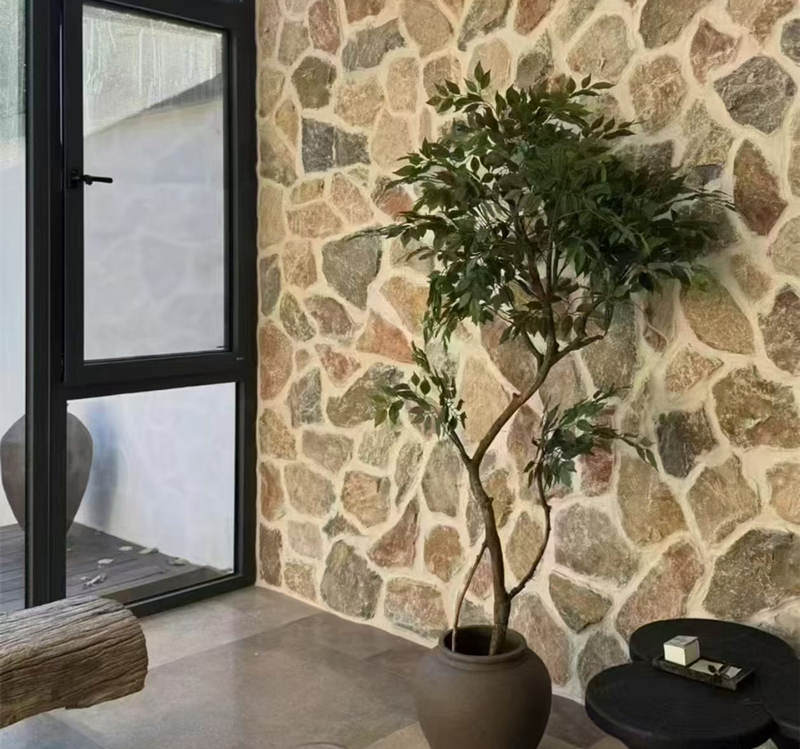
The thin stone veneer vs manufactured decision for a commercial facade isn’t about which looks better at a sample board. It’s about which material you can defend to the GC and the client when the first freeze-thaw cycle hits in year three. For a veteran architect specifying a 50,000 sq ft healthcare campus, the margin for error is zero.
Most comparison articles stop at “natural stone is authentic” and “manufactured is lighter.” That misses the real engineering gap. Natural stone’s water absorption sits below 0.5%, while manufactured stone’s cement matrix pulls in 5-8% moisture by weight. That single number dictates freeze-thaw longevity, efflorescence risk, and whether you’ll be writing a corrective spec in 15 years. The cost delta—$20-35/sq ft installed for natural versus $12-20 for manufactured—only matters if both materials survive the building’s design life.
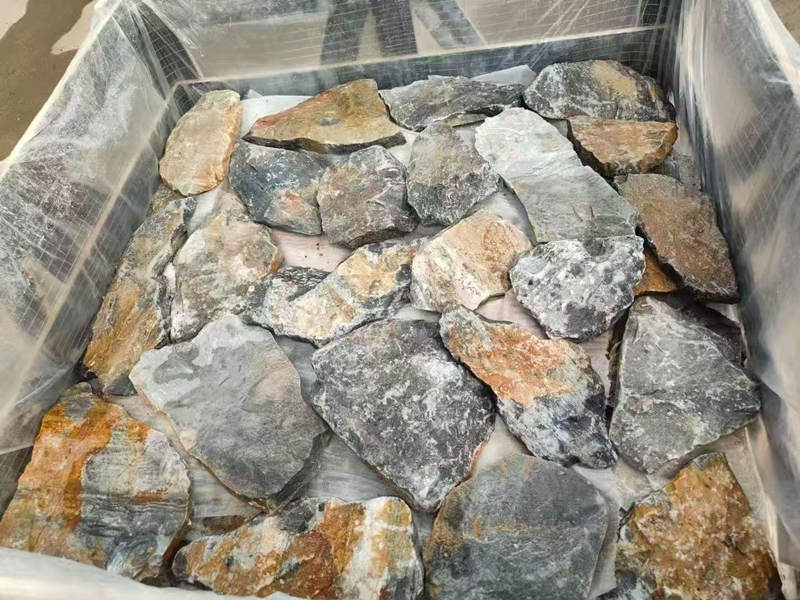
Class A Fire Rated Natural Stone Veneer Panels vs Manufactured Aesthetics
Natural grain is not decorative — it is structural.
Every piece of natural stone carries a unique mineral pattern, cleavage plane, and color variation formed over millions of years. Manufactured stone uses molds cast from a single rock face, then repeats that same texture across thousands of square feet. Under raking light — especially on a south-facing facade — that repetition becomes obvious. The human eye catches it at 10 feet. At 3 feet, the illusion collapses.
Geological and Material Performance Criteria:
- Geological Variation Matrix: Natural stone’s grain, veining, and color shift across the same pallet. This is not a defect — it is proof of authenticity. Manufactured stone’s ‘grain’ is a surface-level texture stamped into cement. No depth. No shift.
- Permanence Signal: Institutional facades — courthouses, healthcare campuses, university entries — demand a material that reads as permanent. Natural stone’s irregularity signals age and stability. Manufactured stone, no matter how ‘realistic,’ reads as product, not place.
- UV Pigment Degradation: Manufactured stone’s color comes from iron oxide pigments mixed into cement. UV exposure breaks those pigments down. After 10-15 years in Class III freeze-thaw zones, the facade fades. The cement matrix itself may hold, but the color does not. Natural stone’s color is mineral, not pigment. It does not fade. Period.
The spec-level takeaway: Manufactured stone’s ’50-year warranty’ covers structural defect, not aesthetic fade. For a 50-year building, natural stone’s grain is not a style choice — it is a liability choice.
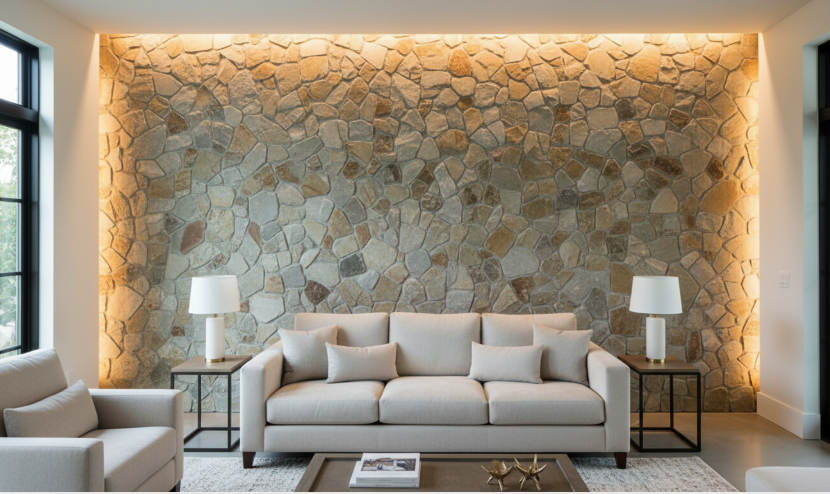
Real Stone vs Faux Stone Cost Comparison for Contractors: 50-Year Lifespan Forecast
Natural stone costs more upfront but yields zero planned mid-life replacement costs.
The upfront cost difference is clear: thin-cut natural stone veneer runs $20-$35 per square foot installed. Manufactured stone veneer runs $12-$20. That $8-$15 gap per square foot is real. But the question a veteran architect asks is not ‘What is cheaper?’ It is ‘What is the total cost of ownership over 50 years?’
Lifecycle Cost Projections:
- Natural Stone Lifecycle: Installed at $20-$35/sq ft. Zero recoating or replacement needed. ASTM C666 freeze-thaw tested. 50+ year lifespan. Total cost: $20-$35/sq ft once.
- Manufactured Stone Lifecycle: Installed at $12-$20/sq ft. Manufacturer marketing touts 50-year warranty but fine print typically excludes fading, efflorescence, and freeze-thaw spalling after 15-20 years in Class III zones. Replacement adds another $12-$20/sq ft. Total cost over 50 years: $24-$40+/sq ft.
Run the numbers on a 20,000 sq ft facade. Natural stone: $400,000-$700,000 once. Manufactured stone: $240,000-$400,000 now, plus $240,000-$400,000 again in 15-20 years. That replacement delta adds an extra $80,000-$160,000 overall. That is a line item a GC will remember. And that is assuming the second install goes cleanly — it never does.
The hidden risk: manufactured stone’s cement matrix absorbs 5-8% moisture by weight. In freeze-thaw Class II/III climates (think Chicago, Boston, Denver), that moisture freezes, expands, and spalls the face. The manufacturer’s warranty covers manufacturing defects, not environmental weathering. You are on your own after year 15. Natural stone at 0.5% absorption? No freeze-thaw risk. No fade. No callbacks.
| Feature | Thin Natural Stone Veneer | Manufactured Stone Veneer | 50-Year Lifecycle Cost Insight |
|---|---|---|---|
| Initial Installed Cost | $20 – $35 / sq ft | $12 – $20 / sq ft | Natural stone: $0 replacement cost. Manufactured: Potential $80k+ for panel replacement after 15-20 years. |
| Lifespan Expectancy | 50+ years (geological durability) | 15-25 years in freeze-thaw zones; up to 50 years in mild climates | Natural stone outlasts building design life. Manufactured may require mid-life overhaul. |
| Water Absorption Rate | <1% (near-zero porosity) | 5-8% (cement matrix absorbs moisture) | Low absorption prevents freeze-thaw spalling & efflorescence, eliminating repair costs. |
| UV & Color Stability | Inherent pigment; no fade over 50+ years | Pigment fade & color shift possible after 10-15 years | No need for repainting or panel replacement due to color loss. |
| Freeze-Thaw Resistance (ASTM) | Passes ASTM C666 (300+ cycles, <0.5% mass loss) | Passes ASTM C1262; risk of micro-cracking in Class III zones | Natural stone’s superior resistance prevents costly structural repairs in harsh climates. |
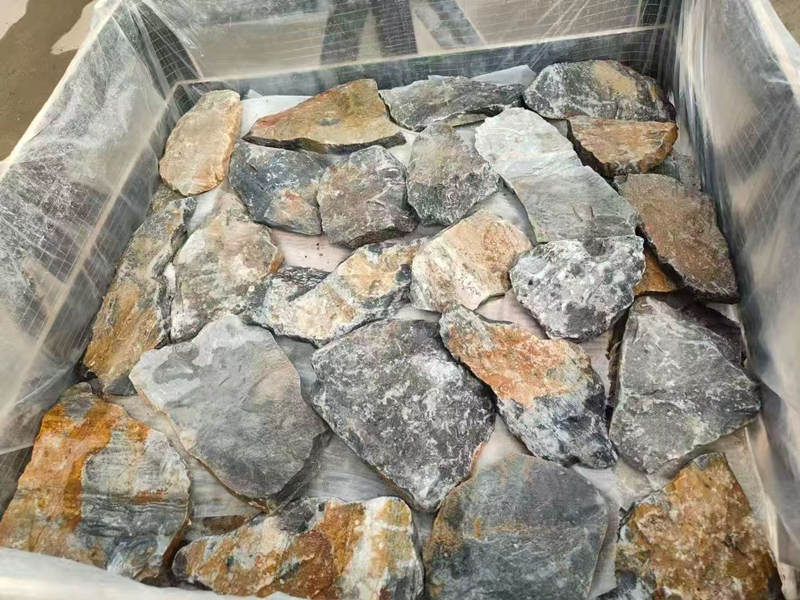
Commercial Exterior Thin Stone Veneer Substrate Requirements and Weight Limits
Weight difference dictates substrate prep—metal lath for natural, direct bond for manufactured configurations.
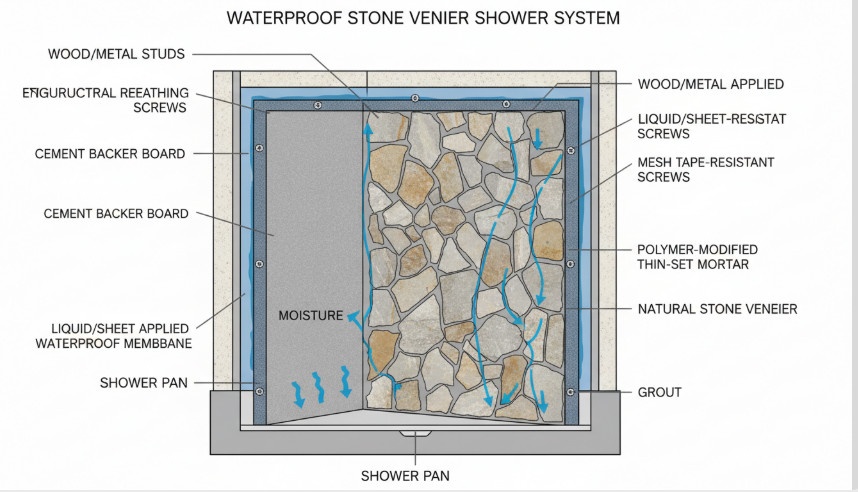
Thin natural stone veneer at 0.75–1.25 inches thick weighs 12–18 lbs per square foot. That load requires a metal lath and scratch coat over a code-compliant weather barrier. Manufactured stone veneer, by contrast, weighs 8–12 lbs per square foot—roughly 40% lighter—which allows direct adhesion to CMU, plywood, or light-gauge steel framing without the lath step. That weight savings cuts substrate preparation time by roughly one day per 2,000 square feet, a real factor on phased commercial builds.
Installation Engineering Criteria:
- Substrate Requirement: Natural stone needs ASTM C1063-compliant metal lath, a 3/8-inch scratch coat, and 24-hour cure before setting. Manufactured stone can bond directly to clean CMU or exterior-grade plywood using a polymer-modified mortar, skipping the lath step entirely.
- Cutting Fragility: Manufactured stone’s cement matrix is brittle. Wet saw cuts with a continuous-rim diamond blade produce clean edges; a dry blade or angle grinder chips the face, creating visible defects that require patching. Natural stone’s crystalline structure handles cutting with less edge spalling, but the blade wear tracks higher.
- Color Blending Skill: Natural stone arrives in pallets that vary in hue. A 5,000-square-foot facade requires blending from 40+ pallets simultaneously—a skill that adds 10–15% to labor cost. Manufactured stone ships with consistent color across all boxes, so the installer stages from a single production run.
Verify Batch Color Consistency in Natural Stone Ledger Panels vs Faux Stability
Manufactured stone guarantees temporary color uniformity but fails under direct solar UV exposure paths.
For a multi-building retail campus or senior living facility where brand guidelines demand identical facades, manufactured stone veneer (MSV) wins on repeatability. Every mold produces the exact same hue. No on-site blending, no pallet-to-pallet variation. That is a real advantage when the owner’s sign-off depends on a single Pantone reference.
But uniformity comes at a cost you cannot see in the showroom. MSV relies on integral pigments mixed into a cement matrix. Those pigments degrade under UV exposure. After 10–15 years in a freeze-thaw Class III zone (US climate zones 5–7), fading becomes visible. Efflorescence — white salt deposits — often appears sooner. The 50-year warranty many brands advertise typically excludes fading, efflorescence, and cosmetic change. Read the fine print.
Traceability and Quality Control Factors:
- Moisture Absorption Pitfalls: Manufactured stone’s cement matrix absorbs 5–8% moisture by weight. Natural stone (slate, quartzite, limestone) absorbs <1%. That 5–8% directly drives freeze-thaw spalling and micro-cracking — the primary failure mode in commercial facades.
- Batch Traceability: Natural stone from a single quarry, like Top Source Stone’s same-source slate and quartzite, can be color-matched across multi-year production. Request a 10-panel sample lot and a written batch guarantee before specifying. For manufactured stone, demand the pigment batch record and UV stability test report (ASTM D4587).
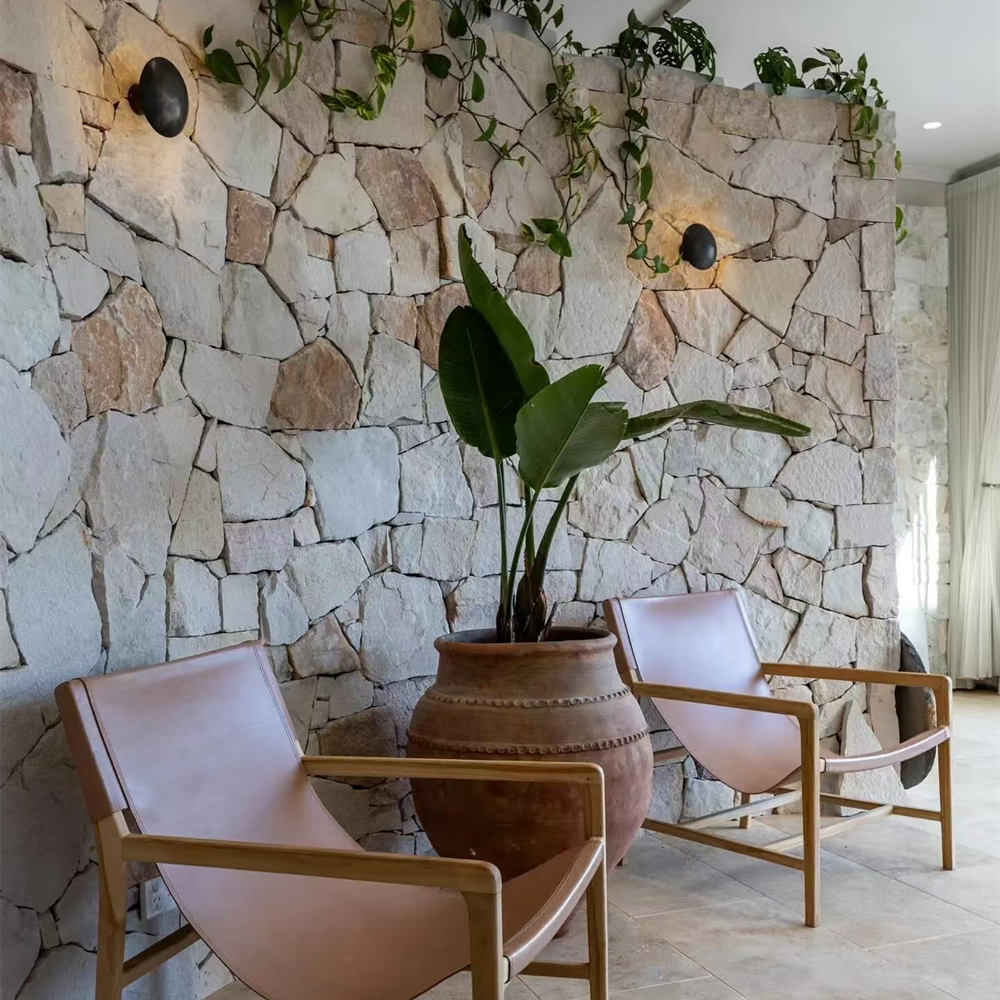
- Visual Proximity Test: Manufactured stone looks convincing at 10 feet. At 3 feet, under raking light, the uniform surface texture and absence of natural grain become apparent. For high-end mixed-use lobbies or institutional entrances where occupants walk within arm’s reach, natural stone’s geological variation signals permanence.
The architect’s decision here is not about which is prettier. It is about liability. If you specify manufactured stone for a 20,000 sq ft healthcare facade and it fades unevenly by year 12, you own that callback. Natural stone does not fade. Its color comes from mineral composition, not pigment. That is a spec you can defend to the client and the GC for the building’s entire design life.
ASTM C666 Freeze-Thaw Resistance and UV Performance of Stone Cladding
Natural stone absorbs <1% moisture, eradicating mechanical delamination vectors.
The freeze-thaw cycle is the most aggressive test for any exterior cladding. Water seeps into pores, expands by 9% when it freezes, and fractures the material from the inside out. The difference between natural and manufactured stone here is not aesthetic — it is structural.
Durability and Mechanical Weathering Metrics:
- Water Absorption Scales: Thin-cut natural stone (slate, quartzite, limestone) has inherent water absorption under 1% by weight. Manufactured stone veneer (MSV), made from a cement matrix, absorbs 5% to 8% moisture. That 5x to 8x difference is the root cause of freeze-thaw failures.
- Test Standard Mandates: Architects should demand ASTM C666 for natural stone (300 cycles, <0.5% mass loss) and ASTM C1262 for manufactured stone. If a supplier cannot provide these reports, do not spec the product.
- Failure Mode Staging: In freeze-thaw Class III zones (most of the northern US and Canada), manufactured stone shows visible cracking, spalling, and efflorescence after 10-15 years. Natural stone from the same climate routinely exceeds 50 years with zero structural degradation.
The marketing claim of a ’50-year warranty’ on manufactured stone often excludes fading, efflorescence, and cosmetic changes. The fine print matters. For institutional and healthcare projects with a 50-year design life, natural stone is the zero-risk specification.
Sourcing Verification: Natural Thin Stone Veneer Wholesale Factory Procurement Guide
Batch traceability is a contractual liability, not a design preference.
For projects exceeding 100,000 sq ft, the single biggest specification risk is color drift between production runs. Natural stone suppliers must demonstrate they quarry from the same vein across multi-year contracts. Top Source Stone quarries slate, quartzite, and limestone from its own deposits in Yixian, Hebei, and maintains digital color logs for every block. Request a 10-panel sample lot from three different production months. If the supplier cannot deliver that, you are approving a blind spec.
Factory Procurement Protocol Controls:
- Same-Quarry Clause Requirements: Write into the spec that all stone must come from the same named quarry. A supplier who blends material from multiple open-market sources cannot guarantee batch consistency.
- Pigment Batch Control Framework: Manufactured stone relies on iron oxide pigments that drift between batches if the factory does not calibrate per ASTM D2244. Ask for a delta-E report showing ≤1.5 variance across the last five production runs.
- Sample Lot Mockup Protocol: Do not approve a single 12×12 sample. Request a 10-panel lot (minimum 10 sq ft) that represents the full color range. Install it on a mockup wall and photograph under north-facing light. That mockup becomes your acceptance benchmark.
The competitor gap here is significant. Most factory audit checklists stop at ‘visit the factory’ without specifying what to verify. Architects who skip the batch guarantee step often face a 5-15% color rejection rate on site. For a 50,000 sq ft facade, that means 2,500 to 7,500 sq ft of material that cannot be used without visual compromise. The fix is a single paragraph in the spec: ‘Supplier must provide a written batch guarantee ensuring all material shipped matches the approved 10-panel sample within a delta-E of 2.0 under D65 lighting.’
Conclusion
The specifier’s choice between thin natural stone and manufactured veneer boils down to a single question: does the building need to last 50 years without a mid-life facade overhaul? For institutional, healthcare, or monumental projects, the 0.5% water absorption of natural quartzite or slate eliminates the freeze-thaw risk that erodes manufactured veneer’s cement matrix. That is a spec you can defend to the GC and the client.
Review the ASTM C1670 test reports and batch traceability documentation for your next project. The commercial stone cladding solutions page has the data you need to build a liability-proof spec.
Frequently Asked Questions
Is manufactured stone veneer better than natural stone veneer?
No, manufactured stone is not better—it is lighter and more uniform, but natural stone veneer is stronger, lasts longer, and does not fade or crack over time. For a commercial facade cladding submittal, specifying natural thin modules preserves engineering structural reliability lines across heavy winter loads. Spec natural for longevity, manufactured for budget and weight savings.
How long does manufactured stone veneer last?
Manufactured stone veneer typically lasts 10 to 15 years before fading or freeze-thaw cracking in harsh climates. Natural stone veneer, by contrast, lasts 50+ years with no replacement needed. Plan for replacement at year 15 if you go manufactured.
Does manufactured stone look real?
Manufactured stone looks real at arm length but reveals its uniformity under raking light and fades over time. Natural stone’s irregular grain and color variation are impossible to mold accurately. Spec natural for legacy facades where authenticity matters.
What is the thinnest stone veneer?
Thin natural stone veneer can be cut to as thin as 1/4 inch, depending on the stone type. Our thin stone veneer is cut to spec for high-end interior and exterior walls. Confirm min thickness with your project spec before ordering.
What type of veneers look most natural?
Thin-cut natural stone veneers look most natural because they retain real mineral patterns and geological variation. No manufactured product can match the depth and irregularity of real stone. For most natural look, spec thin-cut natural quartzite or slate.
