


When I sit down with a specifier who is early in their sourcing stage, the first question is rarely about aesthetics. It is about risk — specifically, how to specify a natural stone veneer guide that delivers the real stone look without triggering a code violation, a budget overrun, or a call from the GC about color patchiness on a 5,000-square-foot facade. For architects and interior designers, the gap between the material you approve on a sample board and what arrives on the job site can be the difference between a satisfied client and a costly redo.
The fundamental tension in the market is that most US-based guides treat natural stacked stone as a binary choice: it is either real stone or manufactured stone, with little attention to the supply chain mechanics that actually determine project success. Competitors like MSI and Norstone offer solid installation advice, but they consistently avoid the hidden B2B risk of batch-to-batch color inconsistency — the single biggest cause of rejection on large commercial jobs. A direct manufacturer who owns the quarry, like Top Source Stone in Yixian, Hebei, can guarantee 95% hue uniformity by hand-sorting from the same quarry run, a step that distributors aggregating from multiple sources routinely skip. That is not a marketing claim; it is a specifier’s insurance policy.
What Is Natural Stone Veneer? Definition & Core Specs
Real stone veneer is a structural product, not a decorative finish. Spec it wrong and you own the liability for a wall that fails.
Natural stone veneer is 100% genuine stone—slate, quartzite, sandstone, or limestone—quarried from the earth and split or cut into thin sections. It is not a cast concrete product. The result is a material that retains the full geological integrity of the source rock: the same compressive strength, the same freeze-thaw resistance, and the same non-combustible properties as a 4-inch thick building stone, but at a fraction of the weight.
Here are the core specs you need for your specification sheet:
- Weight: 12–15 lbs per square foot. This is the critical number for your structural engineer to calculate dead load on the wall tie system. Compare this to 15–25 lbs/sqft for heavy manufactured stone veneer options.
- Thickness: 0.75–1.5 inches for thin veneer panels. It is designed specifically for adhered application over a cement board or reinforced scratch coat substrate.
- Fire Rating: Class A per ASTM E84. Natural stone is inherently non-combustible. It will not burn, melt, or off-gas toxic smoke under direct flame exposure. This is a non-negotiable spec for fire-rated lobby walls and exit corridors.
- Compliance: ASTM C1670 (Standard Specification for Adhered Masonry Veneer Units) and IBC Section 1405.6 for adhered masonry veneer boundaries.
The critical distinction most guides miss: natural stone does not require an ICC-ES report for code compliance because it is a naturally occurring prescriptive material under the IBC, not a proprietary synthetic assembly. The burden is on the supplier to prove the stone comes from a consistent quarry seam and is free of structural defects like micro-fissures or hidden clay lines.
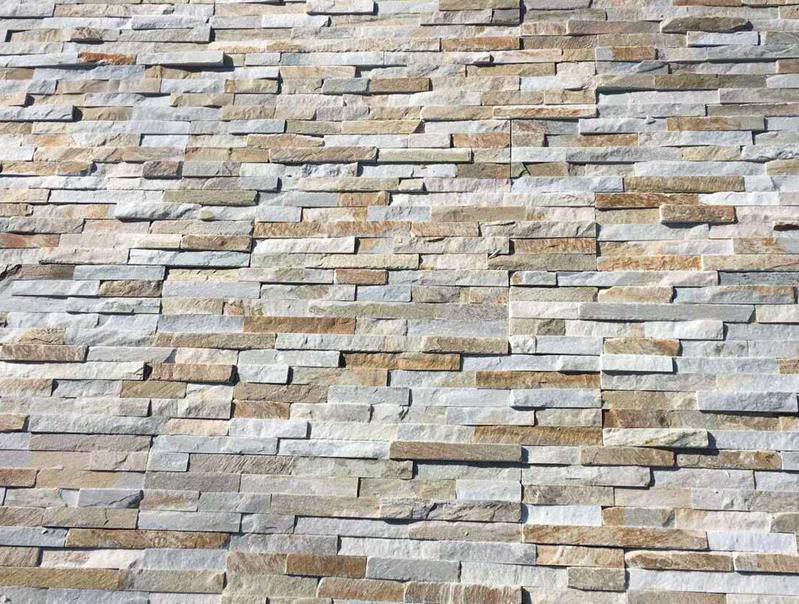
Natural vs. Manufactured Stone Veneer: Key Differences
The core difference is material science, not marketing. Cement-based manufactured products will degrade and fade over time, while real stone values longevity.
Natural stone veneer consists of cut slices of real rock retaining full density, mineral structural integrity, and native crystalline beauty. Conversely, manufactured stone veneer (or cultured stone) is a cast concrete mix—comprising Portland cement, lightweight aggregates like expanded shale, and synthetic iron-oxide pigments poured into surface molds. This elemental composition gap drives long-term performance drift.
The second critical variance lies in color stability and aging behavior. Because manufactured options rely on topically applied surface pigments, they face significant UV fading and mineral efflorescence (white powder deposits) within 3 to 5 years of harsh outdoor weathering. Real stone possesses continuous structural pigmentation across its entire mass; cutting or scratching a panel reveals the exact same geological hue beneath, ensuring generational durability without fading under sunlight exposure.
Ledgestone vs. Stacked Stone: Aesthetic & Technical Differences
The terms description refers to installation styles versus product categories. Realize the visual texture variations before committing your project layout.
A common point of confusion for designers is distinguishing between “ledgestone” and “stacked stone.” Stone veneer is the broad product category—any real stone split thin for cladding. Stacked stone describes an overall installation style—narrow, rectangular pieces arranged in continuous horizontal courses. Ledgestone is a targeted subclass of stacked stone that utilizes stones with more pronounced, rugged split-faces and varied piece depths, accentuating heavy linear shadows across the installation wall.
From a technical standpoint, standard stacked stone is often pre-assembled into interlocking Z-shaped modular ledger panels (typically 6×24 inches) to minimize horizontal seam visibility during mass staging. Individual loose ledgestone requires masonry crews to hand-place each micro-piece on the wet scratch coat layer. This structural distinction dramatically shifts your project labor costs, site waste margins, and final joint detailing on external corners.
Key Specifications for Architectural Specifications
Natural stone is inherently non-combustible. Cement-based manufactured stone can degrade in fire. This is not a debate—it is a material property趋势.
When compiling Division 04 masonry sections, relying on loose visual terms guarantees submittal disputes. Architects must embed rigid ASTM benchmarks into the contract language. While cement binders inside faux products start micro-cracking and spalling at temperatures above 500°F (260°C), natural stone safely handles severe thermal events, preserving structural backing integrity in commercial emergency escape paths.
Incorporate these specific performance parameters directly into your master project specification sheet:
- Weight Ceiling Load: Enforce a maximum 15 lbs/sqft limit under dry states to stay strictly compliant with prescriptively anchored veneer systems.
- Fire Wall Performance: Mandatory Class A testing per ASTM E84 showing a Flame Spread Index of exactly 0 and Smoke Developed Index under 5.
- Freeze-Thaw Resistance: Demand comprehensive verification sheets validating 50+ test cycles under ASTM C666 with zero structural mass degradation.
- Color Variance Cap: Require spectrophotometer certification tracking batch uniformity under a maximum Delta E ≤ 2.0 boundary.
| Specification Category | Specification Detail | Performance & Compliance |
|---|---|---|
| Material & Composition | 100% Natural Stone (Slate, Quartzite, Sandstone) | Non-combustible, ASTM C1670 Compliant |
| Weight & Thickness | 12–15 lbs/sqft; 0.75–1.5 inches | Meets IBC Section 1405.6 for adhered veneer |
| Fire Rating | Class A (ASTM E84) | Superior to cement-based manufactured stone |
| Color Consistency Guarantee | 95% hue uniformity per batch (hand-sorted) | Eliminates visual patchiness on large facades |
| Sourcing & Cost Advantage | Direct from quarry owner (Yixian, Hebei) | 30–40% cost reduction vs. US distributor markups |
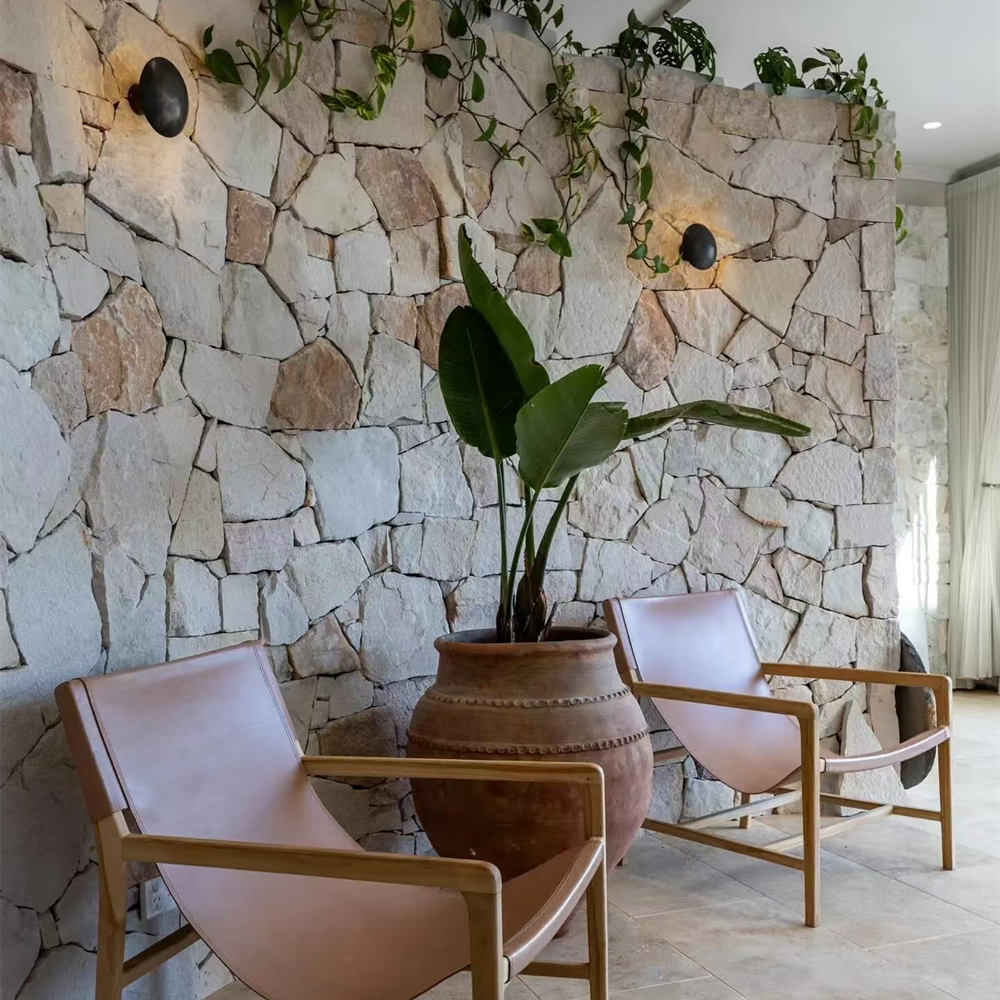
How Sourcing Directly from a Quarry Manufacturer Reduces Risk
A US distributor adds 30–50% to your material cost and introduces batch risk by aggregating stone from multiple quarries. A factory that owns the quarry eliminates both.
The biggest hidden risk in a stone veneer specification isn’t the stone itself. It’s the supply chain. When you buy from a US distributor, you’re paying for warehousing, logistics, and a sales commission. But the real problem is batch integrity. Most distributors do not own quarries. They buy from multiple sources to fill an order. That means the stone arriving in week one may come from a different geological vein than the stone arriving in week three. The color shift is subtle—until the wall is lit and the client sees a patchwork.
A direct manufacturer who owns the quarry, like Top Source Stone in Yixian, Hebei, controls the entire extraction and processing chain. This eliminates the multi-source risk entirely. Here is how the economics and quality assurance break down:
- Cost reduction: Sourcing directly from a quarry manufacturer cuts material costs by 30–40% on orders over 5,000 sqft compared to US distributor pricing. For a 10,000 sqft facade, that is a savings of $15,000–$25,000.
- Batch consistency: A single quarry run produces stone with uniform mineral composition and color. Top Source Stone hand-sorts and pre-blends every order from the same quarry block to guarantee 95% hue uniformity across the entire shipment.
- MOQ flexibility: Custom color blends require a minimum order quantity of 1,000 sqft. Standard blends are available at lower MOQs. Compare that to a distributor who may require you to purchase an entire container to justify the logistics cost.
The practical consequence for you as a specifier is simple: you can write a “match to approved sample” clause with confidence because the factory can reproduce that sample from the same quarry block. A distributor who aggregates from multiple sources cannot make that guarantee. If you are specifying for a commercial project where visual consistency is non-negotiable, the direct sourcing model is the only way to lock in that guarantee without paying a premium。
Installation Requirements & Substrate Prep
Even premium 12-15 psf stone cladding will shear off a commercial feature wall if the substrate prep ignores structural substrate rules.
Sourcing code-compliant material solves only half the structural equation; the masonry assembly must be securely fastened to prevent structural failure. Adhered veneer weighing up to 15 lbs/sqft under IBC Section 1405.6 cannot be directly hung over standard painted drywall or raw exterior wood sheathing. The underlying framing back-structure must be strictly rated for an L/720 deflection minimum to handle brittle masonry loads without micro-cracking.
For interior commercial installations, mandate an approved cement backer board (such as Durock or HardieBacker) screwed firmly to studs every 8 inches on-center. For demanding exterior building envelopes, the installation sequence requires a robust weather-resistant barrier (WRB), a 1/4-inch drainage plane gap framework, structural metal lath, and an engineered scratch coat. Furthermore, code mandates a clear 2-inch grade clearance above unpaved earth to block continuous water wicking and freeze-thaw damage at the floor transition lines.
Conclusion
Specifying natural stone veneer correctly means balancing aesthetic authenticity with strict performance criteria: weight under 15 lbs/sqft, a Class A fire rating per ASTM E84, and compliance with IBC Section 1405.6. The primary risk you face—visual inconsistency across a large facade—is avoidable when you source from a manufacturer who controls the quarry and guarantees 95% color uniformity within a single production batch. This data-backed approach eliminates guesswork and protects your project from costly callbacks.
Review the product specifications for Top Source Stone’s pre-sorted, hand-blended ledger panels to see how direct quarry sourcing delivers consistent color and a 30–40% cost advantage over US distributor markups. Compare the available stone types and finish options to match your project’s specific aesthetic and code requirements.
Frequently Asked Questions
What is the difference between natural stone and stone veneer?
Natural stone is full-bed, solid rock weighing 30–40 lbs/sqft, while stone veneer is real stone cut to 1–1.5 inches thick, weighing under 15 lbs/sqft. The key difference is that veneer eliminates the need for concrete footings or structural shelf angles. Specify veneer for lightweight cladding; use full stone only for load-bearing applications.
What is the difference between ledgestone and stackstone?
Ledgestone features a horizontal, linear pattern with varied stone lengths, while stackstone has a more uniform, brick-like stacked appearance. The choice comes down to whether you want a rugged, layered look. Match the pattern to your project’s architectural style before ordering samples.
Is stacked stone out of style?
No, stacked stone remains a strong choice for accent walls, fireplaces, and exterior cladding, especially in modern and transitional designs. It has evolved from a trend into a staple, but its material selection dictates its lifespan. Always verify current regional preferences with a local distributor before specifying.
What are the disadvantages of stone veneer?
The main disadvantages are higher material cost compared to manufactured stone and the need for skilled installation to avoid moisture issues or visible seams. Natural stone veneer must be installed over a rigid, engineered substrate to completely avoid shear failure. Order a full sample panel and confirm installation warranty before committing to a large order.
What is the difference between stone veneer and stacked stone?
Stone veneer is a broad category of thin stone cladding, while stacked stone is a specific installation style where stones are arranged in tight, mortarless-looking joints. Clarify with your supplier whether you need a stacked pattern or a random ledger pattern for your spec.
