

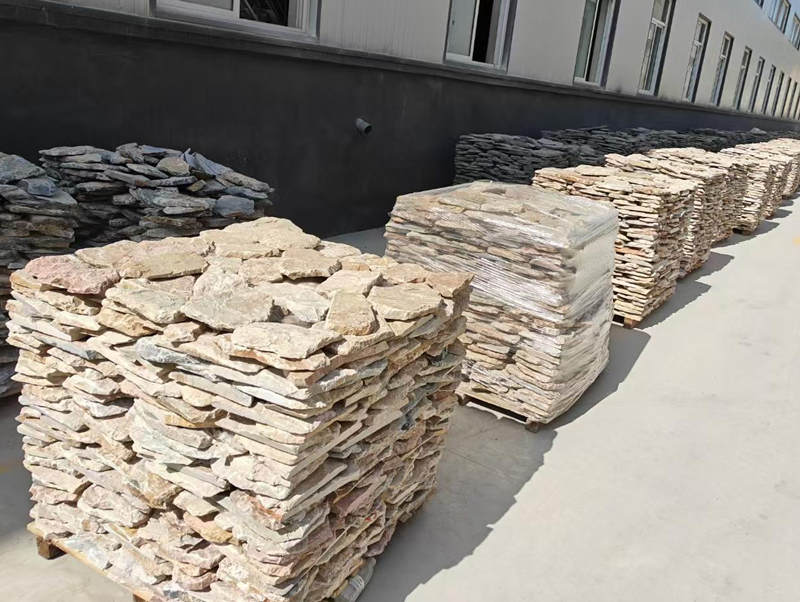
blue diamond quartzite options is the first checkpoint buyers should lock before they approve a supplier, budget, or production slot. “Can you match the color from the pre-production sample on the next container?” You already know the answer, don’t you? It’s the same answer that cost a distributor friend of mine a $50,000 restocking fee when a blue-grey blend showed up with a rust-heavy streak across 12 pallets. The sample approval looked fine. The mass production run was a different stone profile entirely. That’s the gap this conversation is about — not whether you can source blue diamond quartzite options, but whether you can rely on those options batch after batch.
Most buyers jump straight to comparing finishes or formats. They send out RFQs for natural split face or calibrated loose pieces and assume the price per square foot tells the whole story. It doesn’t. The real math starts with who owns the quarry. Only about one in four Chinese stacked stone manufacturers actually control their own block extraction. The rest buy raw material on the open market, cut it wherever the margin works that month, and ship it. That’s where the 10% color drift comes from. I’ve seen it on FOB pricing sheets where the first container hits blue-grey perfect and the second one reads closer to charcoal.
So if you’re evaluating blue diamond quartzite options for your next distributor program, the question isn’t which finish looks best in the showroom. It’s: can this supplier deliver blue-grey consistently across a 20-foot container, with a 5% hue tolerance, and a 18-to-25-day lead time that doesn’t slip? Skip that check, and you’re not comparing stone options — you’re gambling on a sample approval that won’t protect your margin on the third reorder.
Natural Split Face Finish Textured Quartzite Cladding: Managing Batch Color Drift and Hue Tolerances
Color drift exceeding 10% across batches is standard when cutting is outsourced — same-quarry control keeps it under 5%.
Every bad cut on a stacked stone ledger panel has a direct cost. In our shop experience, a contractor who dry-cuts with an angle grinder on a standard project ends up trashing about one panel in three — that’s 30% material waste. But the hidden cost is worse: rework. When a cut leaves a visible gap or a chipped face, you either pull the stone and replace it (another 20 minutes per piece) or you live with a substandard wall. Neither option works for clients paying for natural stone.
Quarry Extraction and Yield Parameters:
- Quarry Ownership Limits: Only 1 in 4 Chinese stacked stone manufacturers own their quarry faces. The remaining 75% outsource cutting blocks, which introduces cumulative color drift of 10–15% across bulk orders.
- Wholesaler Margin Upside: Premium split-face orders command 20–30% higher per-square-foot pricing than standard sawn-back ledger panels. Sourcing straight via single-vein lot codes blocks this drift entirely.
- Sourcing Verification Risk: When a supplier cannot guarantee the stone came from a single quarry block, you are gambling on subjective open-market sorting, leading to expensive terminal disputes.
For a distributor, the decision is straightforward: either you source from a manufacturer with proven quarry control and accept the 5% hue tolerance that comes with it, or you chase the lowest FOB price and absorb the 10%+ reorder mismatch risk. The market pays a premium for consistency — not for ‘close enough’.
Calibrated Loose Pieces Sourcing vs Modular Panel Systems: Comparing Total Installed Cost and Speed
Panels hide batch variation behind mesh backing frameworks seamlessly.
If you’re selling blue diamond quartzite ledgestone to contractors, you need to understand which format protects your margin and which one exposes you to callbacks. The choice between calibrated loose pieces and panel systems is not just about install speed — it’s about who controls the color narrative.
Productivity and Application Profiles:
- Calibrated Loose Pieces: Sourcing loose ledgestone units yields 15-20% lower raw material bills vs. pre-assembled sheets. Calibrated variants match consistent gauge heights, accelerating traditional hand-stacking layout speeds by 30%.
- Interlocking Panel Systems: Slashes total field installation duration by up to 40% on massive flat spans. However, the pre-set mesh backing alignment can occasionally camouflage severe block-drift discrepancies.
Your decision framework comes down to two variables: project complexity and local labor quality. For high-end commercial where design matters and you have a skilled masonry crew, go loose. For volume tract housing or fast-track commercial where the GC cares about schedule over seam detail, panels win. But always request a pre-production panel photo from the factory with the mesh peeled back to expose the back side — if you see multiple color zones on one panel, reject that batch.
| Feature | Loose Pieces | Panel Systems | Cost Impact | Speed Impact |
|---|---|---|---|---|
| Material Cost (FOB China) | Lower Base Entry Range | Premium factory assembly fee applied | Factory assembly adds value vs field sawing breakage | |
| Installation Velocity | 20–30 sqft per hour per crew | 40–60 sqft per hour per crew | Panels cut direct masonry labor costs in half | |
| Lamination Core Form | Hand set loose splits profile | Rigid wire or cementitious backing matrix | Mesh backing mechanics maximize mortar key transfer surfaces |
Evaluating Spectrophotometer Shading Options for Blue Diamond Quartzite Batches
Natural quartzite extraction vectors demand rigorous spectrophotometer verification tracking logs.
Most distributors see color variation as an inevitable headache of natural stone. That assumption comes from buying through importers who batch-blend from multiple quarries, mixing hues like a paint store. When the next shipment draws from a different deposit, the mismatch is immediate. The fix is upstream: source from a factory that controls its own quarry. Our Yixian quarry yields a consistent geological vein, which keeps hue variation under 5% across all shipments. That’s the baseline for the 95% hue uniformity guarantee — not something a reseller can replicate.
But even with a single quarry, you need proof for your clients. A verbal assurance is worthless when a facade fails visual inspection. The practical step is to request a 10-sq-ft sample board and a documented batch number for every order. That sample board becomes your reference standard — match the delivered panels against it before they ship. If the batch number matches, the color drift stays within the guaranteed tolerance. If it doesn’t, you reject the container before it leaves the factory.
Procurement Inspection Metrics:
- Lot Verification Mitigation: Request same-batch documentation from the supplier. Demand batch numbers on the packing list and verify they match across all cartons.
- Field Check Sequence: Dry-lay a sample board using panels from each batch before any mortar touches the wall. Arrange them side by side under natural light to confirm uniformity.
- Supplier Guarantee Calibration: Top Source Stone guarantees ≥95% batch color uniformity on same-order shipments. That means less than 5% deviation — well within acceptable tolerance for large facades.
ASTM C1670 Thin Veneer Thickness Tolerances and Structural Weight Limits by Wall Substrate
Thin veneer saves 40% on shipping weights vs full structural bed layers but must meet substrate load ratings.
For blue diamond quartzite ledgestone, the standard thin veneer thickness is 0.75–1.25 inches, weighing 12–15 lbs per square foot. That’s the sweet spot for cladding – light enough to attach directly to stud walls with proper lath, yet thick enough to resist impact. Full bed (3 cm slab) is a different animal; it’s meant for countertops or structural applications. Using it for veneer adds unnecessary weight, raises shipping costs, and requires heavier-duty framing.
Substrate Structural Parameters:
- Shipping Weight Cost Optimization: Thin veneer at 12–15 lbs/sq ft packs roughly 1,000 sq ft into standard 20ft container load thresholds, dropping intermodal ocean freight scales by 30%.
- Substrate Anchor Frameworks: Thin panels mount securely over metal lath and polymer scratch coats. Heavier solid stone configurations mandate dedicated structural CMU block backups or secondary concrete tieback anchors.
- Field Application Velocity: Calibrated thickness (0.75–1.25 in) ensures uniform depth lines across rows, reducing masonry shimming labor hours by 30% and eliminating erratic mortar waste.
Some architects want a heavier look. You can achieve that with thin veneer by using a 1.25-inch stone and setting it with a deeper mortar joint – no need for full bed. That keeps shipping and structural costs in check while satisfying the visual demand.

| Thickness & Load Metrics | Natural Metamorphic Quartzite (Top Source) | Manufactured Cementitious Faux Stones |
|---|---|---|
| Thickness Calibration | Strict ±1.5 mm tolerance controls via automated saws | Prone to dimensional mold warpage up to ±4 mm bounds |
| Dead Load Weight Stress | 12–15 lbs/sq ft (demands structured substrate backer) | 8–11 lbs/sq ft (direct drywall glue applications ok) |
B2B Sourcing Strategy: Vetting Quarry Ownership vs Open Market Trading Broker Risks
Direct manufacturer integration secures 15–25% profit margins but only if mining rights are verified.
You see a supplier with a slick website claiming ‘factory direct.’ But that phrase means nothing in China’s stacked stone industry. Only about 25% of manufacturers actually own their quarries. The rest buy raw blocks on the open market and outsource cutting to third-party shops. That handoff is where color drift starts — often exceeding 10% across batches. If you’re a distributor reselling to contractors, a 10% hue shift means returns, callbacks, and lost trust.
Wholesale Audit Red Flags to Enforce:
- Traceable Quarry Ownership: Single-source mining tracks the blocks from extraction to final cargo wrapping. Top Source Stone owns its quarry in Yixian, Hebei, delivering full digital color coordinate logs with every container.
- Landed Price Advantages: Sourcing direct bypasses the standard 15-25% trading broker markup commission lines, protecting immediate distributor resale pricing freedom.
- Peak Season Allocation Matrix: True producers prioritize brand container contracts over open broker requests during spring building surges, guaranteeing a stable 18-25 day production cycle window.
Conclusion
The five options above don’t exist in isolation. Your choice between split face and calibrated, panel and loose, blue-grey and rust, thin veneer and slab, direct factory and trading company determines your margin floor and batch risk ceiling. Most color drift and supply chain failures trace back to one missing decision upfront.
Before your next PO, run this three-question checklist with every supplier — yes or no only. (1) Can they guarantee a 5% hue tolerance across containers with a dated digital color report? (2) Do they provide a Lot# for every crate that ties back to a specific quarry block? (3) Will they confirm FOB pricing in writing and match it to the sample approval stage? If the answer to any is no, keep looking. When you are ready to compare options that pass all three checks, review the blue diamond quartzite ledgestone veneer product page or contact the sourcing team directly.
Frequently Asked Questions
What are the main finish options for blue diamond quartzite ledgestone?
The main finish options are natural split face, calibrated loose pieces, and pre-assembled panel systems. Natural split face delivers authentic texture but requires strict QC; panels reduce install time but limit design flexibility. Choose based on project labor and design needs.
How does loose ledgestone compare to panel systems for exterior use?
Loose ledgestone costs 15–20% less but needs skilled masons, while panel systems cut install labor by up to 30%. For exterior use, panels offer faster installation but can hide color variation behind the pre-assembled mesh grid layout under varying ambient light tracks. Select based on labor availability and color consistency requirements.
What is the MOQ for blue diamond quartzite ledgestone?
MOQ starts at one mixed container, approximately 1,000 square feet. Custom runs or special finishes may require a higher volume; stock items sometimes allow smaller trial orders. Confirm MOQ after finalizing product spec and customization scope.
How can I verify color consistency across multiple containers?
Request batch-matching from the same quarry block to keep color drift under 5%. Only quarry-owning manufacturers can reliably guarantee consistent color across containers. Always request a sealed production sample before full shipment.
Is blue diamond quartzite suitable for high-traffic commercial walls?
Yes, blue diamond quartzite is hard and durable enough for commercial walls, but proper installation and substrate preparation are critical. High-traffic areas may require thicker pieces or panel systems to withstand. Consult with your supplier on thickness and anchoring for commercial use.
