

Calculating stacked stone coverage per 100 square feet sounds like a simple division problem. But when you’re a distributor quoting a commercial lobby job, the margin between a tidy profit and a messy restocking situation lives in the details you didn’t account for. Panel dimensions vary, waste factors shift with wall complexity, and the batch color consistency of natural stone can turn a clean estimate into a costly headache.
The standard 6×24 natural stacked stone ledger panel covers exactly 1.0 square foot. That much is straightforward. The real trick is knowing that you need at least 105 to 110 panels for a 100-square-foot wall—the extra 5 to 10 percent covers cuts, corners, and the inevitable breakage that happens on site. Most suppliers don’t talk about batch hue variance either. A single batch can shift 3 to 5 percent in color; ordering that extra 5 percent from the same production run saves you from paying a premium later to match a mismatched order. Direct factory sourcing cuts 15 to 25 percent off the per-panel cost by removing the middleman, which is exactly the kind of margin protection a distribution buyer needs when material costs already feel tight.

Why Accurate Stacked Stone Coverage Estimation Matters for Commercial Project Budgets
A 20-panel gap on a 500 sq ft lobby costs $200+ in reorders plus project delays.
Distributors who underestimate coverage by even 5% on a 500 sq ft commercial lobby end up 20 panels short at $8–$12 per panel. That $160–$240 reorder gets slapped with expedited freight and a three-day job-site gap – easily eating 10% of your margin on that project.
Over-ordering is no better. Surplus inventory from one job sits in your warehouse collecting dust. Natural stone has batch-to-batch color variation of 3–5% hue shift; leftover panels from a different run won’t match the next project, forcing discounted sales or write-offs.
Core Procurement Risk Variables:
- Panel Dimension Discrepancies: A 6″x24″ panel from Top Source Stone delivers exactly 1.0 sq ft coverage. Many manufacturers trim or split panels smaller to cut cost, pushing actual coverage down to 0.85–0.95 sq ft. If you assume 1.0 sq ft on a 500 sq ft wall using undersized panels, you’ll be short 25–75 panels.
- Waste Factor Dependency: Straight walls with few outlets need 5% waste. Walls with inside corners, windows, or curved sections push that to 10%. Stone type matters too – split-face ledgestone breaks unevenly at cuts, increasing waste by another 2–3% versus cut-faced panels.
Most suppliers don’t disclose batch size or color drift data. Ordering an extra 5% from the same production batch – a service Top Source Stone offers on orders of 100–200 sq ft – eliminates the expensive nightmare of reordering a color match. The cost of that extra 5% is less than half the cost of a single expedited reorder.
The Real Landed Cost of Miscalculating Stacked Stone Sourcing Orders
Miscalculating coverage costs you 15–25% in reorder fees and structural project delays.
Stacked stone ledger panels typically wholesale at $8–$15 per square foot. For a 100 sq ft wall, that’s $800–$1,500 in base material. Now add the waste factor—5% for straight walls, 10% for walls with corners or angles—and the real cost starts to climb before you’ve cut a single panel.
Project Waste and Material Overhead Projections:
- Straight Wall Matrix (5% Waste): 105 panels needed at $8–$15 each = $840–$1,575 total material cost lines.
- Complex Wall Framing (10% Waste): 110 panels needed at $8–$15 each = $880–$1,650 total material allocations.
- Factory-Direct Margin Safeguard: Sourcing from a direct factory like Top Source Stone eliminates a 15–25% middleman markup. That alone can drop your per-panel cost by $1.20–$3.75, directly protecting your resale margin.
The hidden killer is batch color variation. Even within the same quarry, a 3–5% hue shift between production runs is common. Ordering only 100 panels without accounting for waste forces you to reorder from a different batch—and the color mismatch will force discounts on the leftover stock. The approved practice here is to add 5% extra from the same production batch. Your supplier’s batch traceability data makes this possible; most retail sources won’t share that information.
| Scenario | Panels Ordered | Waste Factor | Total Cost (USD) | Hidden Risk |
|---|---|---|---|---|
| Accurate Estimate (5% waste, same batch) | 105 | 5% | $1,050 | None – batch consistency ensures color match |
| Underestimate (no waste factor) | 100 | 0% | $1,000 | Shortage – reorder cost + expedited shipping (~$200 extra) |
| Overestimate (10% waste factor) | 110 | 10% | $1,100 | Excess inventory – carrying cost + potential discounting |
| Ignoring batch color variation | 105 | 5% | $1,050 | Color mismatch – forced discount up to 15% or restocking fee |
6×24 Ledger Panel Dimensions vs. Actual Coverage Square Footage Area
Nominal panel size can mislead; grout joint alignments reduce effective coverage footprint by up to 5–10%.
A 6″x24″ ledger panel is labeled as covering 1.0 sq ft, but that assumes zero grout lines and perfect fitting. In practice, you lose 5–10% of that nominal area to the 1/4″ to 3/8″ joints between pieces. For a 100 sq ft wall, that means you effectively need coverage for 105–110 sq ft of panel material—not 100 panels, but 105–110 panels. Distributors who ignore this gap end up ordering short and scrambling for a match from a different batch.
Technical Dimensional Constraints:
- Grout Line Loss Impact: Standard 1/4″–3/8″ joints reduce effective coverage of a 6″x24″ panel from 1.0 sq ft to roughly 0.90–0.95 sq ft. Always add a 5–7% waste factor for straight walls, 10% for complex walls with corners or windows.
- Ledger Panels vs Loose Ledgestone: Modular panels offer vastly accelerated field installation velocity. Loose alternatives require high cutting overheads, dropping yield boundaries down to ~20-25 sq ft per ton.
- Panel Count Estimation Formula: Number of panels = (Total Sq Ft ÷ Panel Coverage Sq Ft) × (1 + Waste %). For 100 sq ft with 1.0 sq ft panels and 7% waste: 100 ÷ 1.0 × 1.07 = 107 panels. Never round down.
- Dead Load Weight Reference: Thin veneer ledger units weigh considerably less (15–20 lbs per sq ft vs 25–30 lbs for loose blocks), yielding vastly superior coverage square footage footprints per structural container ton.
The real trap most distributors hit: using nominal dimensions without accounting for batch color shift. Ordering exactly 100 panels for a 100 sq ft wall means any breakage or cut waste forces a reorder. That reorder likely comes from a different production batch, introducing a 3–5% hue variance. The fix is simple—order 5% extra from the same batch. Factory-direct suppliers like Top Source Stone will hold same-batch inventory for you. Retail suppliers rarely offer that traceability, leaving you to discount mismatched leftovers or eat the cost of a full redo.
| Panel Type | Dimensions | Coverage (sq ft) | Waste Factor | Notes |
|---|---|---|---|---|
| Standard Ledger Panel | 6″H x 24″L | 1.0 | 5–10% | Order +5% from same batch for color consistency. |
| Inside Corner Panel | 6″H x 12″L | 0.75 | 5–10% | Subtract corner area before panel calculation. |
How to Calculate Stacked Stone Square Foot Estimation Formula Step-by-Step
For standard 6″x24″ ledger panels, 100 sq ft requires 105-110 panels including waste logs.
Accurate coverage estimation directly impacts your margin. Under-order by 5% and you’re hit with expedited shipping and a color mismatch headache. Over-order by 10% and that excess sits in your warehouse tying up capital. The formula is straightforward, but the waste factor and corner subtraction are where most distributors slip up.
Sequence Measurement Actions:
- Step 1 – Measure Width and Height in Inches: Record exact wall perimeters. For example, a 120″ wide by 96″ tall wall yields 11,520 sq in. Do not round early to protect data.
- Step 2 – Convert to Net Square Feet: Divide total square inches by 144. 11,520 ÷ 144 = 80 sq ft net wall area line.
- Step 3 – Determine Certified Yield Coverage: Top Source Stone’s 6″x24″ panels provide exactly 1.0 sq ft coverage per module. Confirm with technical sheets.
- Step 4 – Apply Waste Factor Ratios: Standard straight runs call for 5-7%; complex curved angles mandate 10%. On an 80 sq ft run, a 7% waste lines add 5.6 sq ft, targeting 85.6 sq ft.
- Step 5 – Map Final Material Counts: 85.6 sq ft ÷ 1.0 sq ft/panel = 86 panels total. Always round up to full cartons.
- Step 6 – Deduct Dedicated Corner Elements: A standard 6″x12″ corner unit maps 0.75 sq ft. Deduct corner footprints from base nets prior to processing waste margins to avoid over-purchasing anomalies.
One more critical factor: batch color consistency. Natural stone panels from the same production run have a 3-5% hue variance. Ordering your 5-10% waste from the same batch as the main order eliminates the need for expensive color matching later. Factory direct suppliers like Top Source Stone provide batch traceability and ASTM C666 freeze-thaw certifications — two data points most retailers can’t deliver, but that directly protect your margin when a client demands compliance documentation.
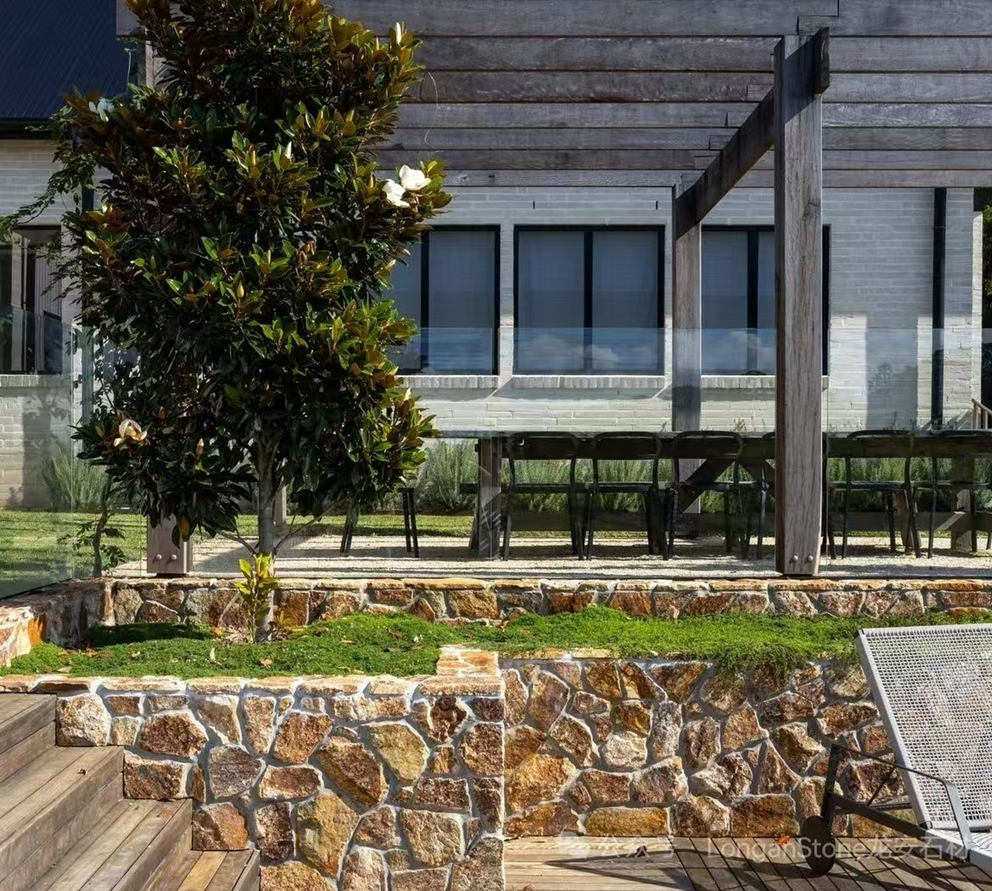
Common Sourcing Mistakes in Estimating Stacked Stone Ledger Panel Shipments
Ignoring waste factor and batch variation parameters can add 15% to material wholesale costs.
Avoidable Material Waste Traps:
- Ignoring Waste Factor Allowances: Standard profiles require 5–7% extra; complex configurations mandate 10% minimal thresholds to avoid running short mid-installation.
- Omitting L-Corner Piece Footprints: Corner segments must be extracted from flat nets early to ensure panel count tracking lines stay perfectly calibrated.
- Relying on Loose Nominal Sizing: Physical module coverage limits vary across producers. Insist on explicit piece data sheets, never unverified catalog averages.
- Disregarding Batch Color Variation: Natural stone lots harbor a native 3–5% hue shift. Lock identical lot IDs upfront to completely secure structural aesthetic boundaries.
Ordering that extra 5% from the same batch eliminates the need for expensive color matching later and protects your margin from inventory write-offs. It’s a small upfront cost that prevents a $200+ reorder plus expedited freight.
Conclusion
Accurate coverage estimation isn’t a math exercise — it’s a margin protection strategy. The difference between ordering 105 panels and 110 panels for a 100 sq ft wall can determine whether you absorb a reorder penalty or walk away from the job with your profit intact. Factory direct sourcing eliminates the 15–25% middleman markup that erodes those margins, and batch traceability prevents the costly color mismatch that forces discounts on leftover stock.
Review the Natural Stone Ledger Panels product page for exact panel dimensions, batch consistency data, and ASTM certifications that support your next bid. You can find the specs needed to lock in accurate estimates — and the supplier transparency that keeps your projects on schedule and on budget.
Frequently Asked Questions
How much stone do I need to cover 100 square feet?
For standard 6″x24″ stacked stone ledger panels, you need 100 panels to cover 100 square feet. Add at least 5–10% extra for waste from cuts, corners, or breakage. Always order 105–110 panels to avoid delays and reorder costs.
How do I calculate how much stone I need to cover an area?
Divide your total square footage by the coverage area of one panel. For a 6″x24″ panel covering 1 sq ft, that number equals panel count, then add a 5–10% waste factor. Multiply base panel count by 1.05 to 1.10 for waste thresholds seamlessly.
How much stacked stone do I need?
Start by measuring the wall’s length times height to get total square feet. For 6″x24″ panels (1 sq ft each), that number equals your base panel count plus 5–10% waste. Use total square footage as your base before adding waste margins.
How much is a stack stone per sq ft?
Wholesale pricing for natural stacked stone panels typically runs $8–$12 per square foot. Factory-direct sourcing from Top Source Stone eliminates middleman markup, lowering per-sq-ft cost. Request a quote for your specific stone type and quantity.
How to estimate stacked stone panel needs for a complex wall?
For complex walls with corners or irregular shapes, increase your waste factor to 10–15%. Measure the wall in sections and account for full panels only in straight runs. Order extra and request same-batch panels to ensure color consistency.
