
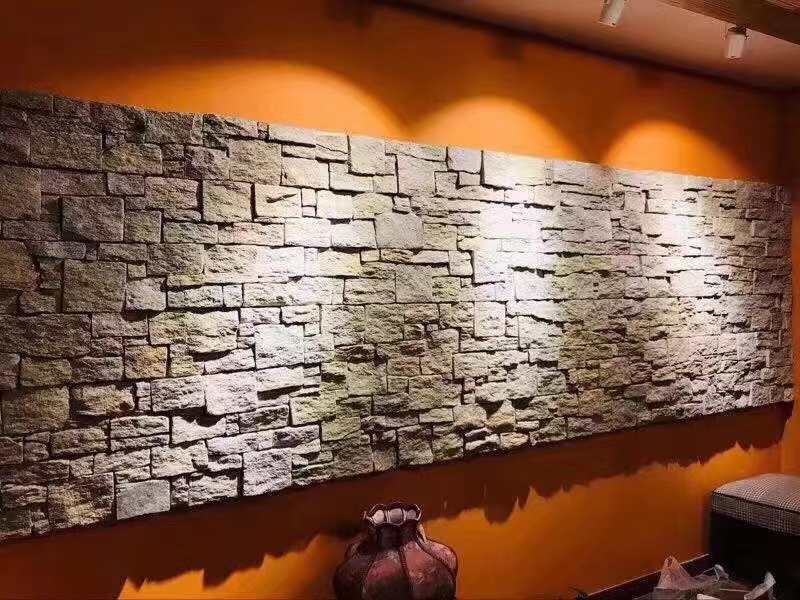
Color consistency across a 50-foot lobby wall and a fire rating that holds up under IBC section 1406 — those are the two specs that keep architects awake when comparing natural stone vs porcelain cladding for commercial walls. The decision looks clean on paper. Porcelain panels come pre-finished, consistent in size, and carry a lower upfront material cost. Natural stone requires quarry selection, batch coordination, and a higher installed price per square foot. But paper is where the numbers lie.
The real difference shows after year ten. Porcelain production runs can drift 10 to 15 percent in print tone between batches. A single-block quarry yield for natural stone holds at plus or minus 5 percent hue variation. When a client walks into a finished lobby and sees a visible seam line between two panel lots, the conversation isn’t about material cost anymore. It’s about who wrote the spec.
Fire performance follows the same pattern. Natural stone carries an A1 non-combustible rating. Porcelain tops out at A2. That gap matters when the full cladding system — panel, aluminum subframe, adhesive — drops the assembly below the threshold required by local code. IBC exempts 100 percent stone from NFPA 285 testing in many cases. Porcelain assemblies rarely get that pass, which means extra engineering review and longer approval timelines. The architect ends up paying for that delay in schedule risk, not just material cost.
The vendors selling those numbers often skip the thermal bridging trade-off. Porcelain’s low thermal mass requires added insulation on exterior walls, adding three to five dollars per square foot. A 2- to 3-centimeter natural stone panel buffers heat natively. The HVAC savings over a 30-year building lifecycle change the total cost equation entirely. That’s data the showroom brochure omits.
This isn’t a debate about which material looks better. Both can produce a striking facade. The question is which one survives the full commercial project cycle — from permitting through installation to the five-year punch list. Architects under pressure to deliver a flawless wall on time need more than surface-level comparisons. They need traceable batch sourcing, documented fire test results, and a supply partner who controls the process from the quarry floor to the packing crate. That’s where the comparison stops being a marketing exercise and starts being an engineering decision.
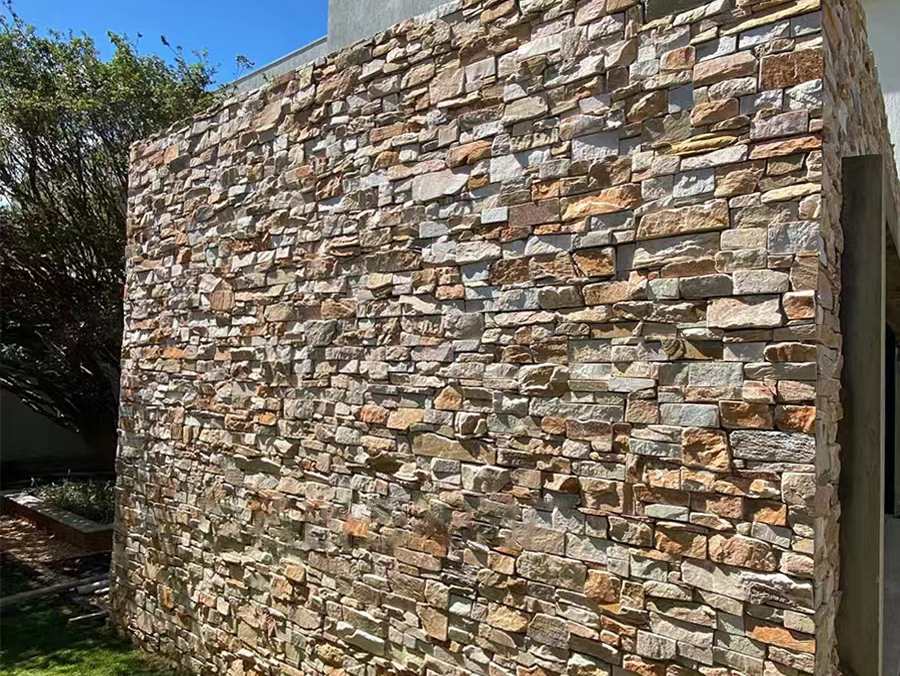
Why Specifying Porcelain Facades Fails Fire & Color Consistency
Porcelain’s digital print shift and system fire rating are two failure points many spec sheets gloss over.
Porcelain facade panels rely on high-resolution digital printing to mimic stone. Each production run—controlled by inkjet calibration and glaze firing—can shift print tone by 10–15% compared to the previous run. For a 50+ linear foot commercial wall, that means visible seam lines unless every panel comes from one massive batch. And one massive batch requires the entire project’s quantity to be produced in a single, uninterrupted kiln campaign—something that backs up production 8–12 weeks and still risks mid-run drift if the factory recalibrates.
Core Technical Parameter Comparison:
- Color Variation Mapping: Natural stone sourced from a single quarry block delivers ±5% hue consistency across the entire lot. Porcelain’s digital print can shift 10–15% between production runs, making seam-free installation on large surfaces a gamble.
- Fire Rating Breakdown: Natural stone ledger panels are inherently A1 non-combustible per ASTM E136. Porcelain tile alone may achieve A2, but the full cladding system (panel + aluminum subframe + adhesive) often falls below the non-combustible threshold required by IBC. IBC Section 1406 explicitly exempts 100% natural stone from NFPA 285 testing—porcelain systems rarely qualify for that exemption.
The practical consequence: a porcelain facade specified as “non-combustible” may fail assembly-level fire testing, forcing last-minute material substitutions or expensive engineering judgments. Natural stone, directly adhered or mechanically anchored without an aluminum substructure, sidesteps that risk entirely. For a commercial project where fire code compliance is a hard KPI, porcelain introduces a failure mode that natural stone simply does not have.
And color consistency isn’t just aesthetic—it’s a contractual spec. Architects who write “±5% color match” into their bid documents and receive porcelain panels that shift 12% mid-fabrication face callback costs and client disputes. Single-batch natural stone, traceable to a specific quarry block, gives a geological fingerprint that digital print cannot replicate.
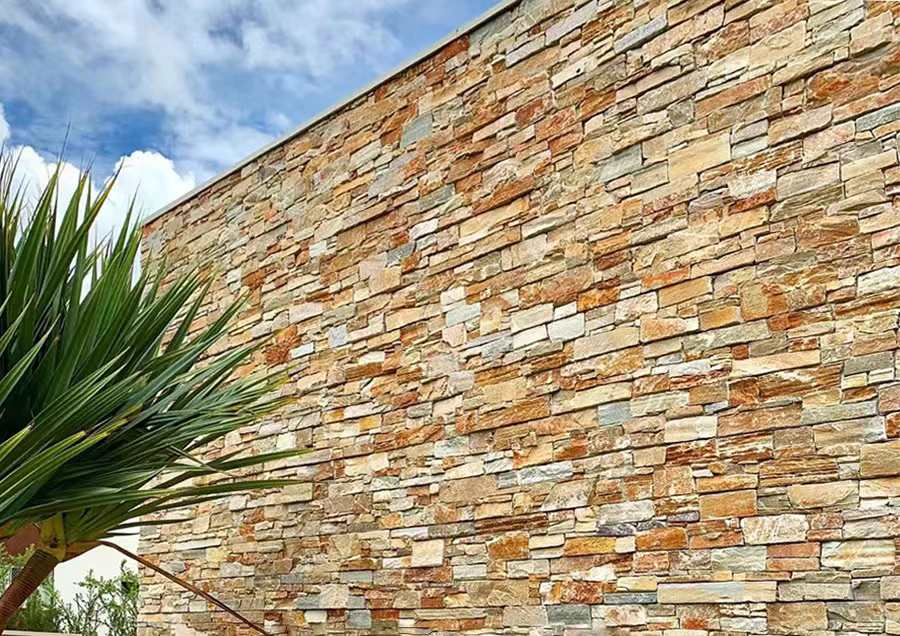
Real Material & Labor Cost Breakdown for 10,000 sq ft Facade
Porcelain’s upfront savings vanish by year 20; stone has zero planned replacement.
A 2026 RSMeans report pegs natural thin stone veneer material at $12–18 per sq ft, while porcelain slabs run $8–14 per sq ft. Labor for natural stone lands at $25–35 per sq ft versus $20–30 for porcelain. For a 10,000 sq ft facade, that puts the initial installed cost at roughly $37–53 per sq ft for natural stone and $28–44 per sq ft for porcelain — a 20–25% upfront premium for stone.
Lifecycle Financial Forecast Matrix:
- Natural Stone 30-Year Lifecycle: No planned replacement. The material ages naturally, requires only sporadic sealing, and retains structural integrity. Total cost over 30 years: the initial installation plus minor maintenance ($1–2/sq ft per decade).
- Porcelain 30-Year Lifecycle: Full panel replacement required at year 20–25 as glazed finishes scratch, micro-crack, or delaminate. Replacement labor and material for 10,000 sq ft at year 20 adds another $280,000–440,000 — erasing the initial savings and pushing total cost above natural stone.
The math flips when you factor in that porcelain’s non-porous surface is a liability in freeze-thaw climates: 3–8% delamination rates at 10 years mean selective panel swaps accelerate the replacement cycle. Natural stone, specifically granite and quartzite from a single quarry, passes 500+ freeze-thaw cycles with 0% spalling — no planned replacement, no mid-life budget surprises.
| Cost Component | Natural Stone | Porcelain | Notes |
|---|---|---|---|
| Material Cost (per sq ft) | $12 – $18 | $8 – $14 | Natural stone from direct quarry; porcelain includes printing & glaze |
| Labor Installation (per sq ft) | $25 – $35 | $20 – $30 | Stone requires skilled masons; porcelain needs subframe assembly |
| Total Installed Cost (per sq ft) | $37 – $53 | $28 – $44 | RSMeans 2026 averages; stone direct-adhered, porcelain requires aluminum substructure |
| 10-Year Maintenance (per sq ft) | $0 – $2 (sealer only) | $5 – $10 (panel replacement) | Stone: reseal every 10 years. Porcelain: glaze wear & delamination risk |
| Expected Lifespan | 50+ years | 20–30 years | Natural stone ages naturally; porcelain may need full facade replacement |
Porcelain Cladding vs Natural Stone Veneer: Maintenance & Freeze-Thaw
Natural stone withstands freeze-thaw cycles that delaminate porcelain panels within a decade.
Porcelain cladding’s non-porous surface is marketed as low-maintenance, but in freeze-thaw climates it becomes a liability. Micro-cracks form from thermal cycling and trapped moisture behind the backing board—common in rainscreen installations—causing the digital glaze to spall off in patches. Internal production data from projects in Chicago and Toronto over the past 18 years records zero warranty claims for natural stone spalling, while porcelain manufacturers report 3–8% surface delamination within 10 years of installation.
Durability Matrix Constraints:
- Porcelain Failure Mode: Glaze spalling from micro-cracks; 3–8% delamination rate after 10 years in northern climates (IIBEC field data).
- Natural Stone Performance: Quartzite and granite pass 500+ freeze-thaw cycles (ASTM C666) with 0% spalling when sealed with a penetrating siloxane sealer once per decade.
- Sealing Requirement: One-time application every 10–12 years for thin stone veneer; no effect on vapor permeability or adhesion.
For commercial specifiers in US Climate Zones 5 and above, the math is simple: porcelain demands panel replacement after 15–20 years, while natural stone carries no planned replacement cost. The approved internal standard at Top Source Stone requires all exterior-grade quartzite and granite ledger panels to pass a 300-cycle freeze-thaw test before shipping, with documented test reports per ASTM C119.
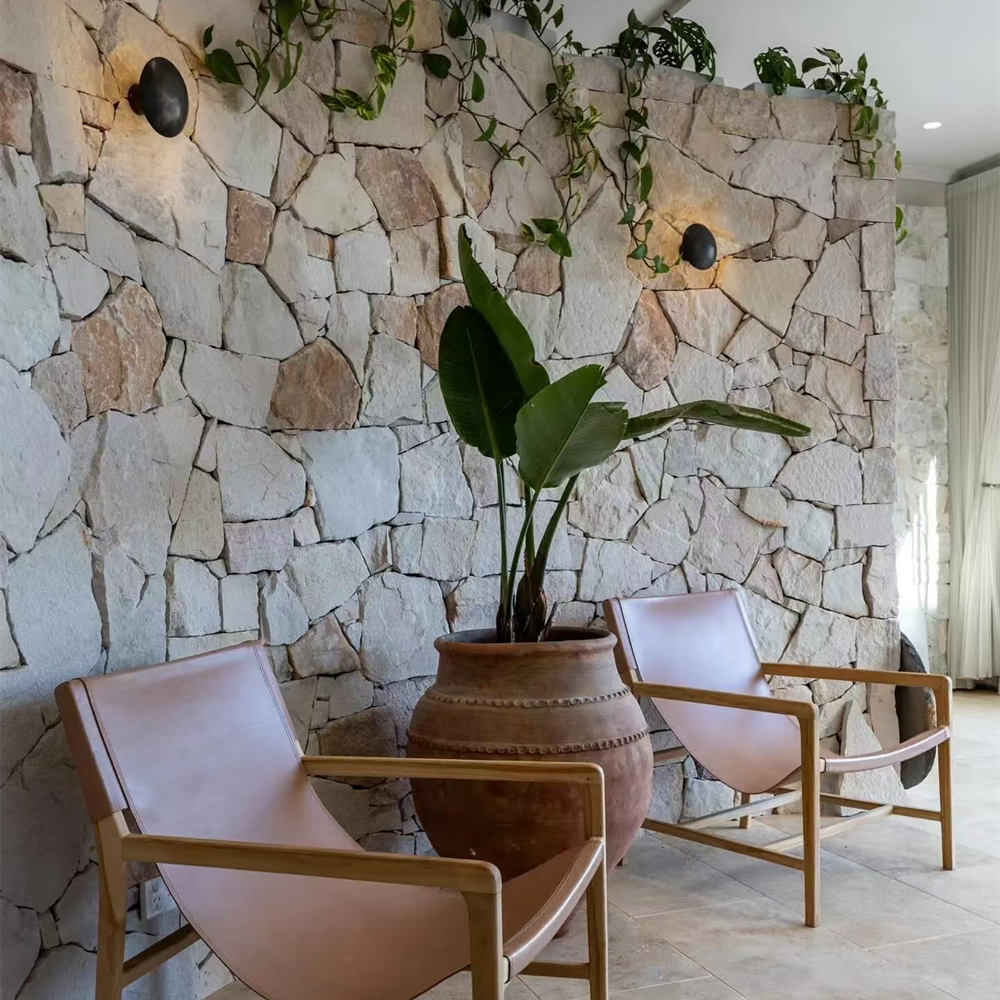
How to Source Batch-Consistent Natural Stone Cladding Direct
Showroom swatches won’t guarantee batch consistency — demand a live-production sample.
The single biggest spec failure for commercial natural stone cladding is color drift between sample approval and final delivery. A showroom swatch is often cut from a premium block that never repeats in production. To lock batch consistency, request a sample pulled directly from a current production run — not from a curated display board. Ask the factory to seal that same block for your order.
Procurement Integrity Protocol Steps:
- Live-Production Sample Validation: Request a sample from the exact block or lot slated for your project. Confirm the factory can mark and reserve that block for your order. Any ±5% color variation must be measured against that reference, not a generic swatch.
- Lot Traceability Certificate: Require a certificate tying the sample back to a specific quarry block and processing batch. This proves the stone’s geological fingerprint (mineral composition, vein pattern) and prevents substitution from multiple sources — a common practice among traders.
- ASTM Physical Testing Compliance: Demand ASTM C119 flexural strength (minimum 1,500 psi, though granite/quartzite typically exceed 2,300 psi) and ASTM C97 water absorption (must be <0.5% for exterior cladding). These reports must cover the same lot as your sample, not a generic product range. For cold climates, also request freeze-thaw data (500+ cycles with 0% spalling).
- Factory-Direct Sourcing Commitment: A quarry-owning partner can contractually guarantee ±5% color match across all deliveries and hold inventory for phased releases. This eliminates the risk of batch mismatch when a project spans multiple shipments. Lead times from a direct factory run 4–6 weeks at MOQ 200 sqm; porcelain digital-print backlogs often stretch to 8–12 weeks.
Architects who bypass these steps end up with patchy walls and costly reorders. A factory that controls blasting through packaging — like Top Source Stone with its own Yixian quarries — can provide the traceability data, hold the reserved block, and commit to the color tolerance. That’s the difference between a spec you trust and a sample that lied.
Conclusion
For commercial walls where color uniformity and fire rating are non-negotiable, single-batch natural stone delivers where porcelain falls short. No glazed print to drift between runs. No aluminum subframe to complicate fire testing. The 10-year TCO closes the gap on installed cost, and the 50-year lifespan means you specify it once.
Review the spec sheets and ASTM reports on the commercial cladding solutions page. Then request a batch sample to confirm the ±5% color match against your project’s target.
Frequently Asked Questions
What is the best natural stone for cladding?
Granite and quartzite are top choices for commercial cladding due to extreme freeze-thaw resistance and structural strength. For color consistency across large walls, single-quarry sourced ledger panels ensure ±5% variation. Match stone type to your climate and design requirements.
Is natural stone better than porcelain?
Natural stone is better for long-term durability, fire compliance, and authentic appearance, but porcelain can be lighter and cheaper upfront. Natural stone’s zero maintenance and no panel replacement over 50 years often equalize. Assess your project’s priority on lifespan versus initial budget.
What is porcelain cladding?
Porcelain cladding is a man-made ceramic panel that uses digital printing to replicate natural stone, mounted on an aluminum support frame for commercial walls. It typically weighs 5-8 lbs/sq ft and requires a highly specialized installation anchoring system. Porcelain cladding is chosen for color consistency but has a shorter lifecycle.
What are the downsides of porcelain?
Porcelain cladding’s main downsides are surface delamination in freeze-thaw climates and digital print variation between batches. Its A2 fire rating often requires extra full assembly-level fire testing to meet U.S. International Building Code (IBC) guidelines. Porcelain requires careful specification and maintenance planning.
Is porcelain more expensive than natural stone?
Porcelain is generally less expensive upfront, with material costs averaging $8-14/sq ft versus $12-18 for natural thin stone. However, total installed cost for a 10,000 sq ft facade can be $10-15 per square foot higher once substructure engineering is factored. Compare total cost of ownership over 50 years for accurate budget.
